
In automotive crash safety, time is limited and expectations are high. Engineers and restraint system teams must deliver validated, traceable results faster than ever, while managing growing model complexity and evolving NCAP requirements.
Yet the biggest delays often happen before the simulation even runs.
Manual, Fragmented and Siloed Workflows
Modern vehicle programs move fast. Simulation cycles are tighter. Targets are higher. Teams are under constant pressure to deliver accurate results earlier in the process. Most development teams experience the same challenges that are slowing down their vehicle development program, including:
Manual Dummy Positioning Fatigue.
Engineers spend valuable hours manually manipulating dummy joint angles to achieve the correct posture. This trial-and-error process is not only time-consuming but prone to inconsistency between users.
Fragmented Pre-Processing.
Standard workflows require separate steps for dummy positioning, seat squashing, and belt routing. This fragmentation delays model preparation for simulation, significantly increasing both the required effort and the overall turnaround time.
Dependency on Senior Experts.
High-quality model setup often relies heavily on the "tribal knowledge" of senior experts. When junior engineers struggle to replicate complex postures, it creates bottlenecks and inconsistent simulation results.
The "Silo" Disconnect.
Ergonomic data (RAMSIS) and crash simulation (LS-DYNA/PRIMER) often exist in separate worlds. Transferring data between comfort and safety teams frequently results in handoff errors and lost traceability.
The result: longer turnaround times, inconsistent models, delayed crash simulation and analysis, and unnecessary program risk.
A Smarter, Faster Occupant Safety Simulation
APT CONNECT® is PRIMER plug-in that provides a comprehensive virtual safety solution designed to streamline and automate occupant safety simulation workflows by integrating dummy positioning, seat interaction, and belt routing into a single, cohesive process, enabling faster, more consistent, and more accurate safety analyses.
As a plug-in for PRIMER, it unifies the pre-processing workflow into a single, automated environment. It improves process efficiency by bridging the gap between ergonomic design and crash safety performance evaluation. By integrating dummy positioning, seat deformation, and belt routing into one streamlined process, APT CONNECT® transforms model preparation from a day-long struggle into a consistent, efficient workflow.
Why APT Connect®?
APT CONNECT® removes these bottlenecks by integrating crash preparation into a single automated workflow inside PRIMER, resulting in faster model readiness, consistent quality, and measurable time savings.
Marker-Based Dummy Positioning
Target marker logic automatically positions Humanetics virtual dummies with repeatable precision, eliminating manual trial-and-error.
Integrated Seat and Belt Processing
Dummy positioning, seat squash, and belt routing are executed simultaneously within one process, removing data handoffs and reducing preparation steps.
Optimized Pre-Simulation Parameters
Dummy-specific, research-backed parameters are embedded in the workflow to accelerate and stabilize pre-simulation runs.
Ergonomics-to-Crash Continuity
Comfort positions from RAMSIS can be directly imported, preserving design intent and ensuring alignment between ergonomic targets and crash validation.
Delivering Measurable Returns
For department heads and procurement teams, APT CONNECT® delivers measurable returns by converting engineering hours into value-added analysis rather than manual setup. APT CONNECT® transforms occupant model preparation from a bottleneck into a competitive advantage.

80% Time Savings
Reduce occupant model setup from 8–10 hours to approximately 2 hours. Teams can meet aggressive Euro NCAP and regulatory deadlines without overtime pressure.

Lower Training Burden
An intuitive, standardized interface allows junior engineers to achieve expert-level setup quality immediately, removing reliance on tribal knowledge.

Cost Savings
Saving up to 1,500 engineering hours per year can translate to approximately $50,000 per vehicle program, while freeing engineers to focus on analysis instead of setup.

Repeatable Validation
Automated positioning ensures consistent, traceable models that reduce validation errors and improve reliability in safety assessments and compliance loops.
Designed for Real-world CAE Environments
APT CONNECT® does not replace your simulation environment. It strengthens the most time-consuming part of it.
- APT Connect® is a native PRIMER plug-in
- Compatible with Humanetics virtual dummy models: Harmonized Hybrid III 5th Female, Harmonized Hybrid III 50th Male, Harmonized Hybrid III 95th Male, HBMC 50th Male*, HBMC 5th Female*, THOR-50M Euro NCAP FE, and THOR-50M US NCAP FE.
- Runs on standard CAE laptops and workstations
- No disruption to existing LS-DYNA workflows
* Only positioning is supported for HBMC 50th Male and HBMC 5th Female models. Other features, seat squash and belt routing, will be available in a future release.
Specifications
Software Requirements
Access to PRIMER is required to use APT Connect®, as it is a plug-in.
Hardware Requirements
Compatible with standard CAE laptops and workstations.
Model Requirements
APT Connect® currently works with Humanetics virtual dummy models:
- Harmonized Hybrid III 5th Female
- Harmonized Hybrid III 50th Male
- Harmonized Hybrid III 95th Male
- HBMC 50th Male*, HBMC 5th Female*
- THOR-50M Euro NCAP FE
- THOR-50M US NCAP FE
* Only positioning is supported for HBMC 50th Male and HBMC 5th Female models. Other features, seat squash and belt routing, will be available in a future release.
Product Resources
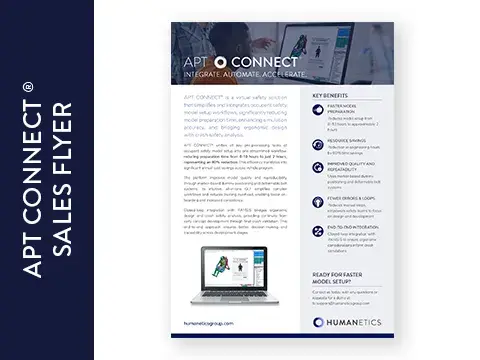

Ready to Accelerate your workflow?
Stop wasting hours on manual positioning. Start building high-quality, validation-ready models in a fraction of the time. Fill out the form below to request a demo or a trial version.
Frequently Asked Questions
What is APT CONNECT®?
APT CONNECT® is an integrated occupant safety simulation solution that automates dummy positioning, seat interaction, and belt routing within the PRIMER environment. It streamlines crash simulation model preparation by connecting ergonomic data from RAMSIS directly to LS-DYNA workflows.
How does APT CONNECT® improve occupant model preparation in LS-DYNA?
APT CONNECT® eliminates manual joint angle adjustments by using marker-based dummy positioning logic. Instead of trial-and-error posture setup, engineers can automatically generate repeatable, validation-ready occupant models, significantly reducing pre-processing time in LS-DYNA crash simulations.
Does APT CONNECT® integrate with RAMSIS?
Yes. APT CONNECT® enables direct import of comfort positions from RAMSIS into PRIMER. This ensures ergonomic design intent is accurately preserved during crash safety simulation and improves traceability between comfort and safety teams.
Which dummy models are supported?
APT CONNECT® is designed to work with Humanetics virtual dummy models used in automotive crash simulation. It ensures consistent positioning and optimized pre-simulation parameter settings for reliable solver performance.
Is APT CONNECT® a standalone software?
No. APT CONNECT® functions as a plug-in for PRIMER. It enhances and automates existing occupant safety simulation workflows without replacing your current LS-DYNA environment.
How much time can APT CONNECT® save in crash simulation model setup?
Engineering teams can reduce occupant model build time from 8–10 hours to approximately 2 hours per configuration. This represents up to an 80% reduction in preparation time, allowing more design iterations within tight vehicle development timelines.
How does APT CONNECT® improve NCAP compliance workflows?
By standardizing dummy positioning and maintaining full traceability from ergonomics to crash validation, APT CONNECT® improves reproducibility and reduces setup-related errors. This increases confidence during Euro NCAP and other regulatory compliance loops.
Can junior CAE engineers use APT CONNECT® effectively?
Yes. The standardized, automated workflow reduces dependency on senior “tribal knowledge.” Junior engineers can achieve expert-level occupant model preparation quality with significantly reduced training time.
What are the system requirements for APT CONNECT®?
- PRIMER (required, as APT CONNECT® operates as a plug-in)
- Humanetics virtual dummy models
- Standard CAE workstation or laptop capable of running LS-DYNA and PRIMER
Who should use APT CONNECT®?
APT CONNECT® is designed for:
- CAE crash simulation engineers
- Restraint system developers
- Vehicle safety teams
- Engineering managers seeking to reduce occupant model preparation time