
Automotive safety teams don’t lose time in simulation. They lose time before the simulation ever starts.
In this article, we'll share how to reduce wasted effort, improve repeatability, and accelerate virtual safety workflows with an integrated pre-processing approach.
The Challenge: Fragmented Pre-Processing Workflows
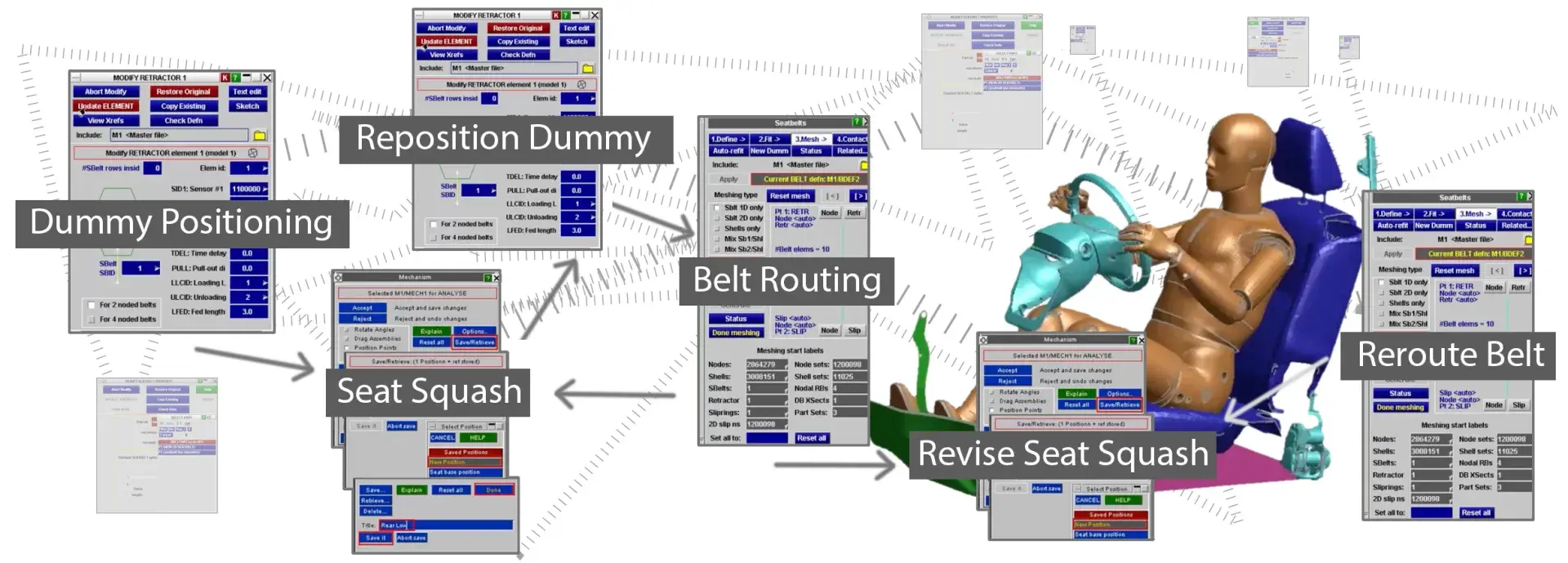
Even with proven solvers and validated dummy models, many CAE teams still rely on manual and fragmented pre-processing workflows. These workflows don't work for today’s development speed or regulatory pressure.
The result is a hidden productivity tax:
- Engineers spending significantly more valuable hours in positioning dummies instead of analyzing results
- Inconsistent and inaccurate setups driven by user experience rather than physics
- Ergonomics intent diluted or lost before design for crash safety even begins
This isn't just a nuisance; it is a hidden tax on your vehicle's program's efficiency and success.
In real world NCAP-driven and VT-driven environments, manual pre-processing is no longer just an inconvenience. It is a workflow bottleneck that slows vehicle development and adds unnecessary program risk.
The Solution: A Single, Automated Workflow
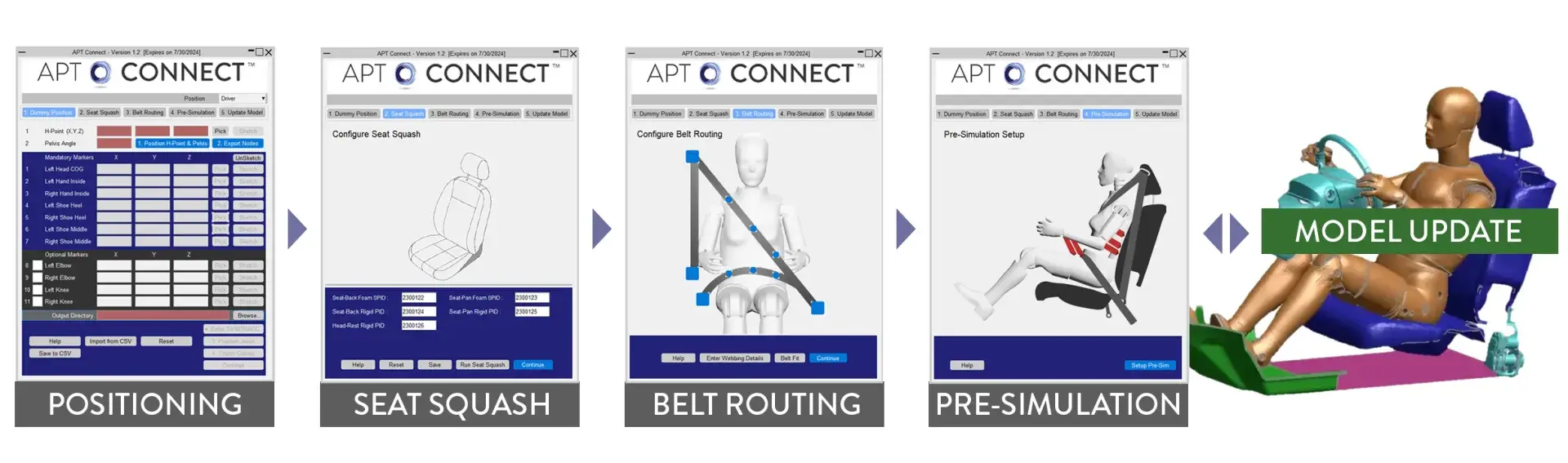
We created APT CONNECT® to unify occupant safety model preparation into one automated workflow. It integrates dummy positioning, seat interaction, and belt routing into a single process, helping teams move from fragmented setup steps to a more consistent and efficient workflow. It offers continuity from RAMSIS comfort positions into crash preparation, preserving ergonomic intent, and improving traceability.
You'll have a single, automated workflow that eliminates the biggest source of inefficiencies in occupant safety CAE. Instead of preparing models step by step, engineers define the target posture, and APT CONNECT® streamlines the key setup steps. The results are faster model readiness, more repeatable setups, and fewer opportunities for user-driven variation.
Ways Increase Your Validation and VT Success
Here are three ways you can streamline your crash safety validations.
1. Eliminate "Tribal Knowledge"
The current standard for model setup takes approximately 8–10 hours per occupant model. Why? Because it often involves multiple separate steps, repeated adjustments, and expert judgment before the model is simulation ready.
The Expertise "Bottleneck"
In many departments, only senior experts possess the "tribal knowledge" required to get complex postures right. Junior engineers struggle to replicate results. This creates bottlenecks. Senior staff get pulled away from high-value analysis to fix basic setup errors.
Here are ways to eliminate this tribal knowledge bottleneck:
- Use marker-based dummy positioning - Target-based logic replaces joint-angle trial and error. Position your virtual dummies automatically and precisely, ensuring repeatability across users and programs.
- Use all-in-one pre-processing - Dummy positioning, seat deformation, and belt routing are executed simultaneously. This removes handoffs, reduces setup time, and accelerates solver readiness.
- Use optimized, dummy-specific parameters - Extensive research-backed parameters are applied automatically, significantly reducing pre-simulation runtime and improving robustness.
2. Stop Wasting Time with Manual Crash Test Dummy Positioning
Manual positioning relies on human judgment. Two engineers can position the same dummy in the same seat and get different results. This variation leads to "misalignments" and unrepeatable postures that risk rejection during VT validation.
Stop Tweaking and Start Analyzing
The job of a CAE engineer should be analyzing crashworthiness and optimizing safety. It should not be fighting with joint angles and belt fitment for half the day.
By automating the tedious elements of model setup, you don't just save time; you gain confidence. This is why leading teams are adopting automated, standardized workflows. It's the standardized solution across all frontal models. This ensures that every simulation run is based on a repeatable, accurate, and crash simulation-ready model.
3. Eliminate "Siloed Data" Between Ergonomics and Safety
Ergonomic data from RAMSIS often sits in a silo, disconnected from the crash team. Transferring this data into CAE is challenging and frequently results in handoff errors, forcing engineers to settle for models that do not accurately capture the intended occupant position and design intent.
The future of simulation is connected. It is no longer acceptable for ergonomic design and crash safety to exist in separate worlds.
A robust virtual safety solution must offer a "closed-loop" process. APT CONNECT® achieves this by importing comfort positions directly from RAMSIS / SAFETY STUDIO. This ensures that the ergonomic design intent is accurately carried over into the crash safety analysis.
This traceability is essential for modern compliance and ensures that what you design for comfort is exactly what you validate for safety.
Interested in More Content Like This?
Subscribe to the Humanetics Pulse newsletter to learn more about Humanetics Products, News, and Industry Updates.
Key Takeaway: Save Time and Scale Expertise
Using these improvements, you can put engineering time back where it belongs.
Engineering managers and procurement teams measure value in time and capacity. By adopting an integrated workflow like APT CONNECT®, departments are seeing a reduction in model build time from roughly 8–10 hours down to just 2 hours.
- 80% time savings: On a standard 64-core system, simultaneous processing allows teams to meet aggressive Euro NCAP and VT compliance deadlines without overtime crunches.
- Scalable expertise: Because the tool uses standardized, marker-based logic, junior engineers can achieve "expert-level" model quality immediately. This democratizes expertise and solves the staffing bottleneck.
- Hard dollar ROI: Saving ~1,500 engineering hours per year translates to approximately $50,000 in savings per vehicle program.
Keep Learning
We have more resources and experts ready to help you improve your crash safety validation.
Ready to Accelerate your workflow?
Stop wasting hours on manual positioning. Start building high-quality, validation-ready models in a fraction of the time. Fill out the form below to request a demo or a trial version.
Frequently Asked Questions
What is Oasys PRIMER?
Oasys PRIMER is a pre-processor for setting up and changing load cases before crash tests in Ansys LS-DYNA.
Which Crash Test Dummies are supported by APT CONNECT®?
APT CONNECT® currently works with Humanetics virtual dummy models:
- Harmonized Hybrid III 5th Female FE
- Harmonized Hybrid III 50th Male FE
- Harmonized Hybrid III 95th Male FE
- THOR-50M Euro NCAP FE
- THOR-50M US NCAP FE
- HBMC 50th Male*
- HBMC 5th Female*
* Only positioning is supported for HBMC 50th Male and HBMC 5th Female models. Other features, seat squash and belt routing, will be available in a future release.
Do I need Oasys PRIMER to use APT CONNECT®?
Yes. APT CONNECT® is a plugin for Oasys PRIMER software. The basic system requirements for PRIMER are:
- Windows 11
- Support for OpenGL
- Get more details on PRIMER technical requirements on their documentation page.
What does the "APT" in APT CONNECT® stand for?
"APT" stands for Accelerated Positioning Tool. APT CONNECT® unifies pre-processing occupant safety model setup into one streamlined workflow. It reduces preparation time from 8-10 hours to just two hours (approximately).

Dr. Anurag Soni
Dr. Soni is an experienced Product Manager at Humanetics Innovative Solutions. He leads the development of advanced digital products that drive innovation in automotive safety and biomechanics. Anurag has over 20 years of experience in occupant safety research and product development. He's contributed to the development of Human Body Models (HBMs) that are now widely used all over the world. His expertise spans HBMs, restraint system design and virtual testing solutions. He's passionate about innovating digital safety and committed to protecting people.