
Safety standards do not stand still.
As vehicles evolve, the tools used to evaluate them and make them safe must improve too. For decades, legacy crash test dummies (today referred to as ATDs) provided the foundation for regulatory testing and consumer safety ratings. They enabled real progress and saved countless lives.
Legacy ATD designers built knowing less than we do now.
Advanced restraint systems, new seating configurations, electrified platforms, and increasingly diverse occupant conditions require a new level of insight. Regulators are responding accordingly.
In this article we'll explain how the THOR and WorldSID crash test dummies solve challenges like these. We'll also share ways to be ready for future changes in your industry.
Table of Contents:
The Shift: What’s Changing
Across the world, New Car Assessment Programs (NCAPs) are shifting to more accurate tests. These tests use more lifelike dummies and represent a wider range of people.
In the United States, there is growing focus on advanced ATDs. The USA is moving to adopt THOR ATDs. These include the 5th percentile female crash test dummy (THOR-5F) and 50th percentile male dummy (THOR-50M).
This is not an incremental update. It marks a step-change in how we define and measure safety.
The Problem: Legacy Tools in a Modern Context
Traditional ATDs such as Hybrid III have served the industry well. But their limitations are becoming more apparent as safety expectations rise.
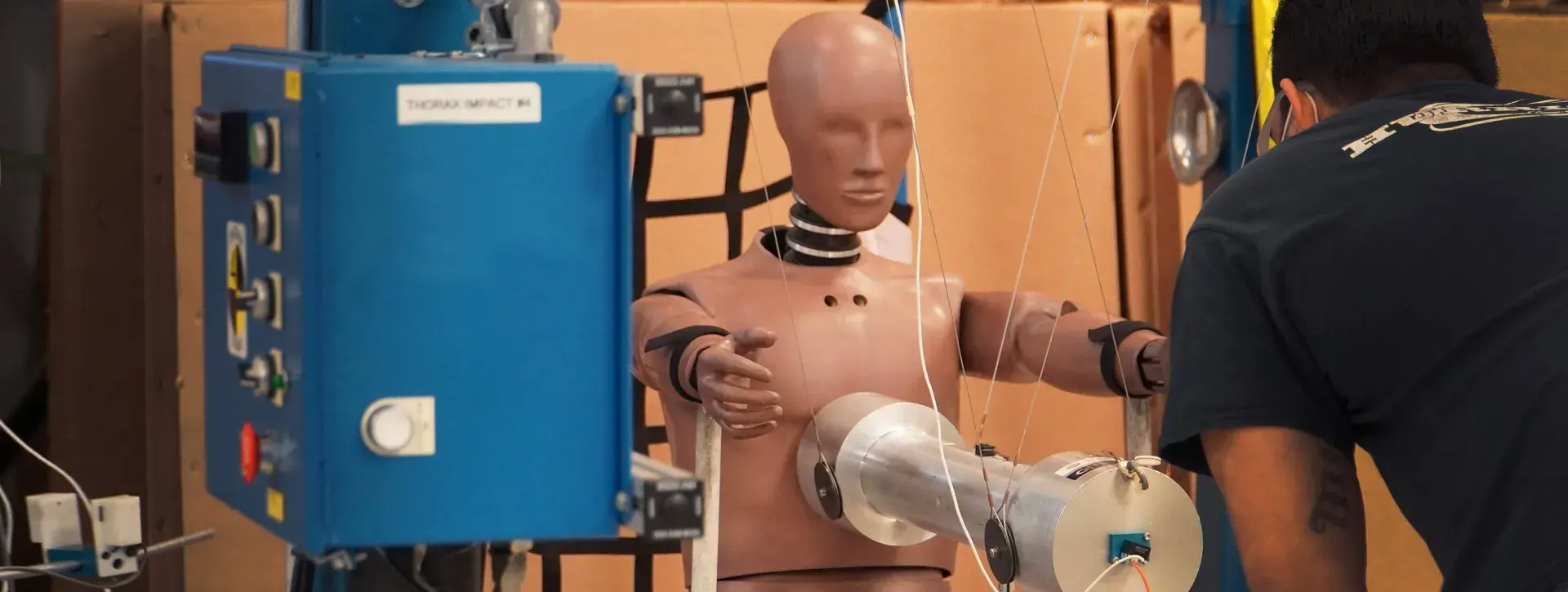
They were not designed to:
- Capture detailed injury mechanisms across the full body
- Represent the diversity of today’s occupant population
- Support advanced restraint system development
- Align seamlessly with modern simulation workflows
- As a result, engineers often face a gap between what can be measured and what needs to be understood.
This gap has implications.
It can limit insight into injury risk. It can reduce confidence in design decisions. And it can create misalignment between regulatory requirements and real-world safety performance.
The Solution: THOR and WorldSID as Next-Generation Platforms
Humanetics’ THOR and WorldSID ATDs represent the next generation of safety measurement systems.
They meet regulatory requirements by design. They also help us better understand how people respond in crashes. That allows for softer vehicle design.
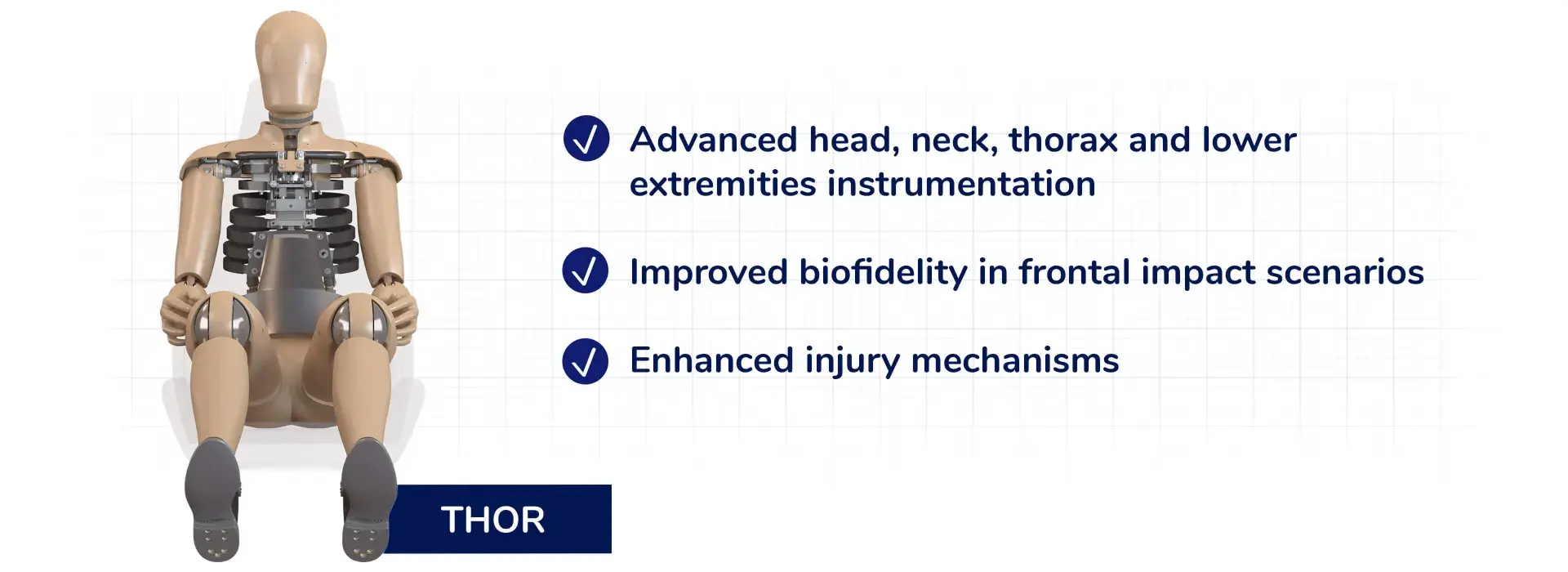
THOR delivers:
- Advanced instrumentation across the head, neck, thorax, and lower extremities
- Improved biofidelity, particularly in frontal impact scenarios
- Enhanced ability to capture injury mechanisms rather than simple thresholds
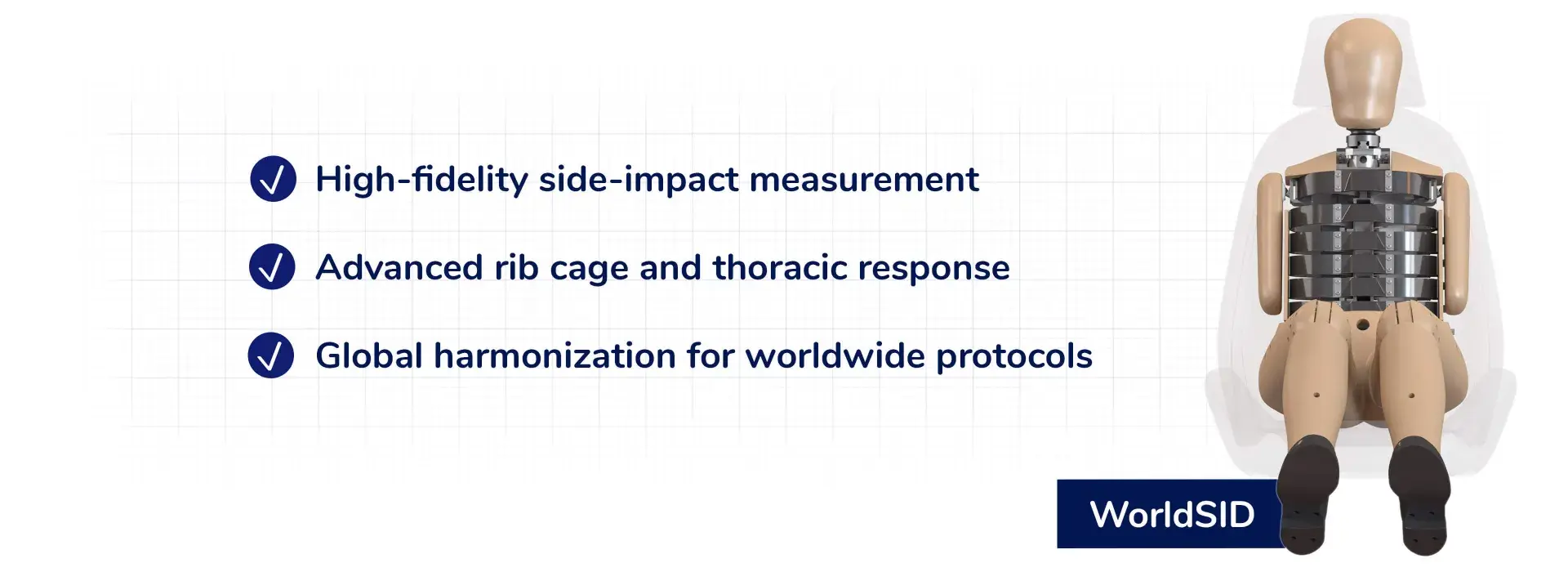
WorldSID provides:
- High-fidelity side-impact measurement
- Advanced rib cage and thoracic response capabilities
- Global harmonization for side-impact testing protocols
THOR and WorldSID are comprehensive platforms for evaluating safety performance across multiple crash modes.
Advanced ATDs like these are used by top automotive OEMs, ship builders, locomotive designers, and in aeronautics.
Ways that THOR and WorldSID Make You Ready for Future Changes in Safety Engineering
These are some of the ways THOR and WorldSID make you ready for future changes.
1: They're More Inclusive
Regulatory and consumer safety programs are speeding up the evolution of ATDs.
NCAP organizations worldwide are increasingly recognizing the need for more representative and biofidelic testing tools. In the United States and Europe, this is clear in the focus on THOR-5F female crash test dummy. This reflects a broader commitment to improve safety for more people.
This shift signals two important trends:
- Safety is becoming more inclusive. Testing is moving beyond a single reference occupant toward a more representative view of real-world populations.
- Measurement expectations are increasing. Regulators are demanding more detailed and more accurate data to support safety ratings and compliance.
For manufacturers, this means that adopting advanced ATDs is the safe long-term bet. Advanced ATDs are moving towards becoming a requirement for staying aligned with future standards.
2: They Deliver More Detailed Data
Frontal Crash Scenarios
In a traditional setup, engineers may use a small set of injury criteria. They focus on key metrics like head acceleration or chest deflection.
THOR makes the picture more complete.
Engineers can access detailed measurements across many body regions, including thoracic response, neck dynamics, and leg loading. This enables a more nuanced understanding of how injuries occur and how systems interact with the occupant.
Side-impact Scenarios
WorldSID provides similar advancements, capturing rib deformation and thoracic response with greater accuracy and consistency.
The result is not just more data, but more meaningful data.
Data that allows engineers to move from evaluating outcomes to understanding causes.
Human Body Models
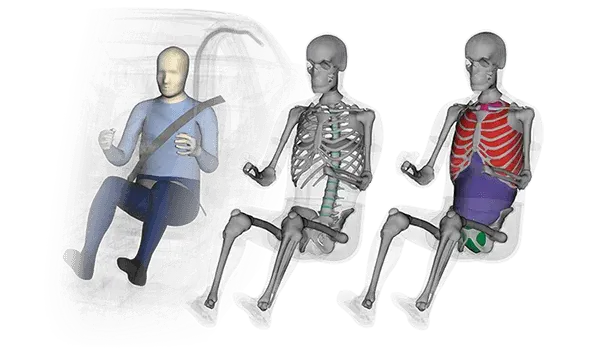
To get even more representative data in virtual testing, engineers are turning to Human Body Models (HBM).
HBMs can simulate bone, muscle, and soft tissue.
3: They Integrate Physical and Virtual with Digital Twins
The evolution of THOR and WorldSID does not stop at the physical device.
A key advantage of Humanetics’ approach is a digital twin ecosystem, where physical ATDs match high-fidelity virtual models.
These digital ATDs are:
- Built directly from the physical design and behavior of THOR and WorldSID
- Validated against real-world test data
- Designed to replicate sensor outputs and injury criteria in simulation
This makes them among the most faithful virtual representations available.
The benefit is significant.
Engineers can run simulation scenarios using digital THOR and WorldSID models that behave consistently with their physical counterparts. This enables:
- Early-stage design evaluation with high confidence
- Reduced reliance on late-stage physical testing
- Strong correlation between virtual and physical results
4: They Help You Build a Closed-Loop System
What truly sets Humanetics apart is not only the quality of its ATDs, physical or digital. It is also the system that connects them.
Through a digital data loop, information flows continuously between:
- Physical crash testing
- Sensor data and instrumentation
- Simulation models and digital twins
- Analysis and validation tools
Physical tests inform digital models. Digital simulations guide physical testing.
Teams share, refine, and reuse data sources across the entire development process.
This closed-loop approach grounds every insight in reality and continuously improves every model. It transforms testing from a series of isolated events into a continuous process of learning.
Interested in More Content Like This?
Subscribe to the Humanetics Pulse newsletter to learn more about Humanetics Products, News, and Industry Updates.
Key Takeaway: THOR and WorldSID Make You Future-Ready
Precision, representation, and integration will define the future of safety.
- THOR and WorldSID enable engineers to capture the complexity of human response with unprecedented accuracy
- Digital twin technology extends that capability into the virtual domain, allowing insight to scale between virtual and physical testing
- And the digital data loop (closed-loop system) connects it all together for continuous improvement and safety intelligence
Safety is evolving. The shift is how well you understand data. And understanding begins with the right tools.
Keep Learning
We have more resources to help you with your safety projects:
- THOR 50th Percentile Male
- THOR 5th Percentile Female
- WorldSID 50th Percentile Male
- WorldSID 5th Percentile Female
- Webinar: WorldSID-50M 3D Thorax Sensors: Accurate Deflection Measurement for NCAP and UN-ECE R135
- Webinar: THOR-5F SBL-C: The Design Behind NHTSA’s Next Safety Standard
- All Webinars
- Human Body Models
Talk to an Expert
No one knows more about vehicle safety testing than we do. How can we help?
Frequently Asked Questions
What is a THOR dummy?
THOR is the latest generation of crash test dummies (ATDs) used for frontal and offset-frontal tests. THOR stands for "Test device for Human Occupant Restraint"
What is a WorldSID dummy?
WorldSID is the latest generation of crash test dummies (ATDs) use for side impact crash testing. Use WorldSIDs to validate for mutlpe government standards all over the world. Side impact testing is important because there is less vehicle structure to protect the occupant.
What does THOR stand for?
THOR stands for:
- Test device for
- Human
- Occupent
- Restraint
What does WorldSID stand for?
WorldSID stands for:
- Worldwide Harmonized
- Side
- Impact
- Dummy
What does ATD stand for?
ATD stands for:
- Anthropomorphic
- Test
- Device
Usually, ATDs are referred to as crash test dummies. But they're much more than a manikin or dummy. An ATD is a highly sophisticated measuring system that is much more advanced than the dummies used decades ago. An ATD has many sensors that can make precise measurements for predicting injury risk.
What is a harmonized crash test dummy?
A "harmonized" crash test dummy (ATD) meets regulatory standards in multiple countries or states. It meets multiple government standards without requiring the purchase and maintenance of multiple dummies.

Mark Brown
Mark is the Product Marketing Manager at Humanetics Safety and works closely with Engineering and Sales to develop and refine content that is both useful and informative for our industry. With over two decades of experience in crash test dummy product Quality, Technical, Sales, and Marketing, Mark produces a wide range of media and publications including our service bulletins, webinars, editorial articles, and contributes to our marketing collateral.