
The Missing Link in Simulation
Safety simulation has become essential to modern safety development.
With simulation, engineers can evaluate more scenarios, iterate faster, and reduce reliance on costly physical testing. But despite these advances, one critical dependency remains: confidence.
The finite element model (virtual dummy) must be accurate, so teams can be confident in the results.
In this article we'll share tips for doing virtual safety testing with confidence:
- The Problem: Simulation Without Correlation
- The Solution: High-Fidelity Virtual ATD Models
- Intelligence in Action: Virtual-Physical Correlation at Scale
In safety engineering, the dummy is not just a tool. The dummy is the core measurement system for human injury.
If the virtual dummy does not behave exactly like its physical counterpart, simulation results lose credibility. Correlation breaks down and confidence drops.
Accurate simulation requires high-fidelity virtual dummies that reflect physical reality.
The Problem: Simulation Without Correlation
Most engineering teams today are already using virtual crash testing.
But many encounter the same challenges:
- Poor correlation between virtual and physical test results
- The cost of a repeat physical test is several hundred thousand dollars if something goes wrong
- Limited confidence in injury predictions
- This leads to more time wasted in meetings seeking explanations, justifications, or understanding
- Inconsistent behavior across different simulation environments
- This can lead to repeating test work or even a lower star rating on the NCAP
- Rework and additional physical testing to validate outcomes
- Can result in slower time to market
All these challenges share the same problem: lack of confidence in the virtual dummy model.
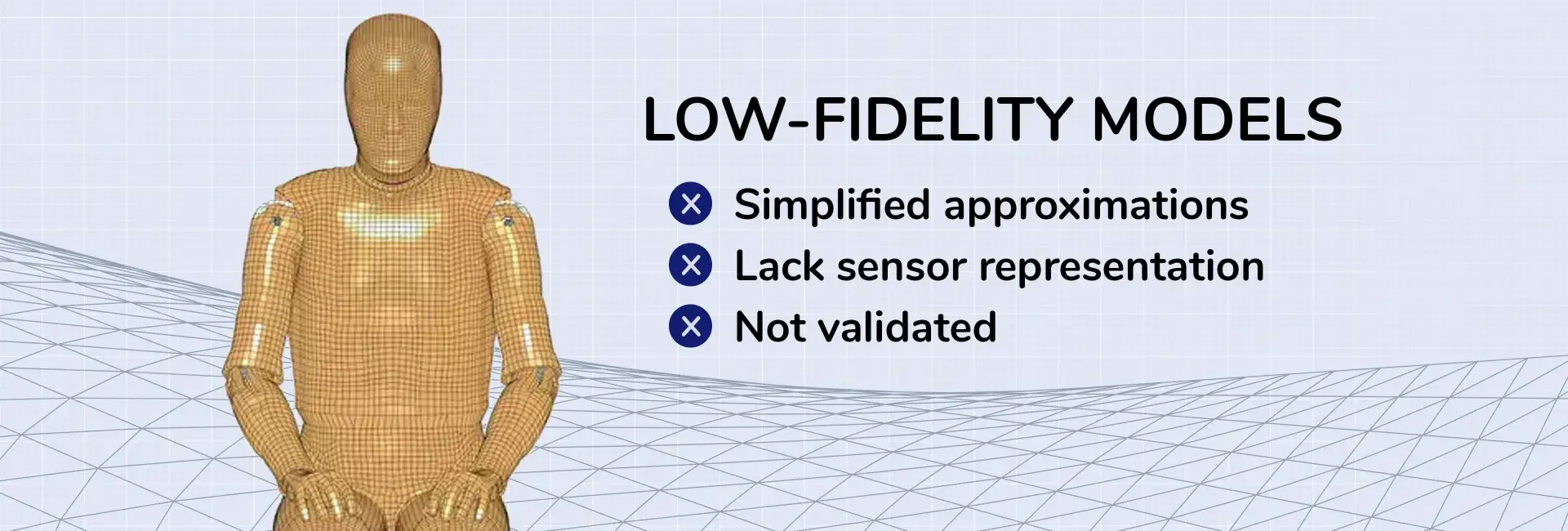
Many models available in the market are low-fidelity. They have:
- Simplified approximations of legacy ATDs
- Lack detailed sensor representation
- Are not fully validated against physical test data
- Are difficult to integrate into a closed-loop workflow
This creates a disconnect. Engineers can simulate faster, but they cannot always trust what they see.
The Solution: High-Fidelity Virtual ATD Models
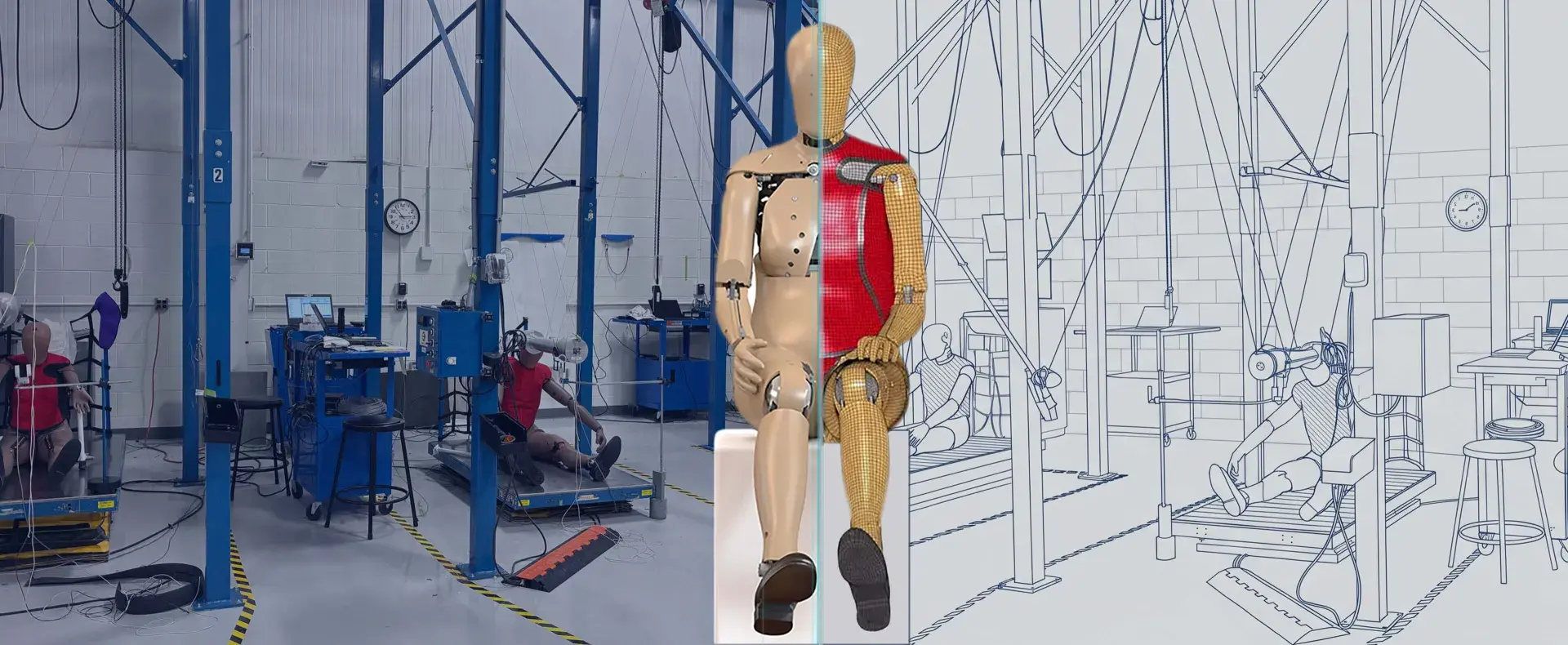
Humanetics designed virtual ATD models to eliminate this disconnect. Instead of serving as digital approximations, they function as verified digital twins.
They are precise, physics-based, and calibrated to behave exactly as their physical counterparts in the lab.
High-fidelity models enable:
- Accurate replication of dummy kinematics and response
- Alignment with physical sensor outputs and injury criteria
- Direct correlation with real-world crash test data
- Seamless integration into CAE workflows
This transforms simulation into a reliable extension of physical testing.
Instead of asking whether results are accurate, engineers can focus on what those results mean.
Intelligence in Action: Virtual-Physical Correlation at Scale
Consider a vehicle development program running both physical crash tests and simulation in parallel.
In a traditional workflow:
- Simulation results must be validated after physical testing
- Discrepancies require rework and calibration
- Iterations are slowed by uncertainty
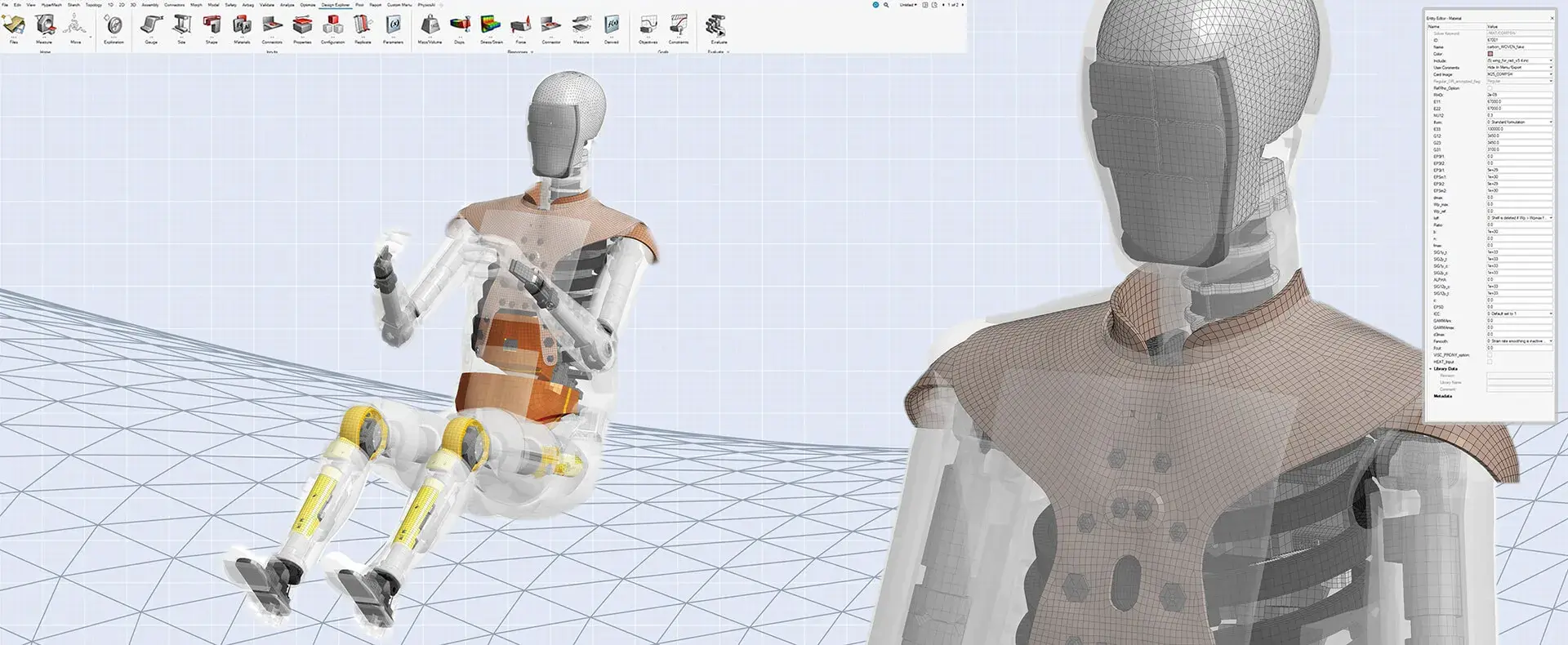
With high-fidelity virtual ATDs, the process changes. Simulation models correlate in advance with physical dummy behavior. When a virtual test is run:
- Injury metrics align with physical sensor outputs
- Kinematic behavior mirrors real-world test results
- Engineers can trust early-stage simulation insights
This allows teams to:
- Identify issues earlier in development
- Reduce the number of physical test iterations
- Focus physical testing on final validation rather than discovery
This is Safety Intelligence in action, where simulation and physical testing operate as one system.
Why Humanetics Virtual ATDs Are Different
The difference between virtual ATDs is not just in their digital construction. The difference lies in how we validate and integrate them.
1. Built from the Physical Source of Truth
Humanetics is the global leader in high quality physical ATDs.
This means our virtual models are:
- Derived directly from the design and behavior of real dummies
- Validated against physical test data
- Refined based on real-world performance
2. Sensor-Level Fidelity and Injury Correlation
Crash test dummies are measurement systems.
Humanetics virtual ATDs replicate:
- Sensor locations and behavior
- Injury criteria outputs
- Signal pathways used in physical testing
This ensures that:
- Virtual results map directly to regulatory metrics
- Engineers can compare physical and digital tests
- Simulation outputs are immediately actionable
3. Proven Correlation Across Physical and Digital Testing
The true test of any virtual model is correlation.
Humanetics models are developed within a closed-loop ecosystem, where:
- Physical test data informs model development
- Simulation results are validated against real-world outcomes
- Continuous feedback improves accuracy over time
This level of correlation is what transforms simulation from a tool into a trusted decision-making system.
Interested in More Content Like This?
Subscribe to the Humanetics Pulse newsletter to learn more about Humanetics Products, News, and Industry Updates.
4: Integration into the Safety Intelligence Ecosystem
Humanetics virtual ATDs are not standalone models.
They integrate the physical and virtual environment:
- Physical ATDs and connected lab systems
- Sensor data and calibration workflows
- Simulation platforms and digital environments
This creates a unified workflow where:
- Data flows seamlessly between physical and digital domains
- Engineers operate within a consistent framework
- Insights are shared across the development lifecycle
Experiencing the Value
Situation - Engineering teams are under pressure to accelerate development while managing increasing safety. Many industries widely adopt simulation, but physical testing still provides the ultimate validation.
Problem - Some virtual ATDs lack correlation with physical dummies, leading to inconsistent results, reduced confidence, and duplicated effort.
Implication - This disconnect results in:
- Increased development time and cost
- Late-stage design changes
- Inefficient use of physical testing resources
- Risk of inaccurate safety assessments
As systems become more complex, these problems compound.
High-fidelity virtual ATDs enable:
- Reliable correlation between simulation and physical tests
- Reduction in physical testing iterations
- Faster identification of safety issues
- Greater confidence in engineering decisions
They allow organizations to move from validating results to trusting them.
From Validation to Confidence
The role of simulation in safety development is evolving.
No longer just a tool for exploring possibilities, it is becoming a foundation for decision-making. But good decisions need trust.
- Trust that virtual results reflect physical reality
- Trust that injury metrics are accurate
- Trust that decisions made early in development will hold true later
High-fidelity virtual ATDs provide that trust.
They connect simulation to the physical world, ensuring that speed does not come at the expense of accuracy.
Key Takeaway: Confident Simulation Depends on Accurate Digital Twins
Crash test dummies have always been central to safety engineering. Their digital twins are becoming just as critical.
High-fidelity finite element models (virtual dummies) extend safety testing into the digital domain. Accurate virtual dummies enable engineers to measure, analyze, and understand safety performance at scale with complete confidence.
Because simulation is not about replacing physical testing. Simulation is about doing more testing, faster, while being more effective. That begins with a virtual model you can trust.
Keep Learning
We have more information about working with finite element models and experts ready to help with your projects.
Talk to an Expert
Contact our virtual model experts to learn how we can help with your projects.
Frequently Asked Questions
What is FE / FEM / FEA?
- FE - Stands for finite element, the basic building block used in breaking down a complex physical problem
- FEM - Stands for finite element method, the mathematical model, theory, and numerical process for solving a physical problem
- FEA - Stands for finite element analysis, the process of using FEM to simulate and predict how an object will behave in the real world
In the context of safety and virtual testing, these 3 abbreviations refer to computer-based simulations. FEA software breaks down physical objects into parts (elements), then runs equations to simulate real-world forces. This type of virtual testing helps reduce the need for physical testing of prototypes, which is costly.
With FEM/FEA, engineers can simulate a crash and predict how the vehicle and occupants will react before they build an actual physical prototype.
What is CAE?
CAE stands for Computer-Aided Engineering. In safety engineering, CAE software tools to run simulations, validate issues, and improve product designs. These tools can do all this before anyone creates a physical mockup or prototype. Humanetics provides CAE tools including Virtual Models and Virtual Modeling software solutions (APT CONNECT® and INSIGHT CONNECT®).
What is a "digital twin"?
A digital twin is an exact virtual replica or copy of a physical object. They enable testing, simulation, and optimization. Often, it’s more expensive and time consuming to test a physical object when it is still in development. Testing with it's virtual replica (digital twin) reduces development time and costs.
Humanetics enables a real-time digital twin for safety testing and certification. We offer physical ATDs (crash test dummies), matching virtual ATDs, and our Connected Lab Management suite.
What is NCAP?
NCAP stands for New Car Assessment Program. It’s a global safety rating system that evaluates vehicle crashworthiness and safety features through standardized crash tests and performance assessments. It provides safety ratings to help consumers make informed decisions and encourage manufacturers to enhance vehicle safety.
Learn more about the Global NCAP Program - https://www.globalncap.org/about
Global NCAP programs include:
What is a Virtual Dummy Model / Finite Element Dummy Model?
In the context of safety and virtual testing, these terms all refer to the same thing.
A virtual dummy model, finite element model, FE model, and FE dummy model all refer to a digital twin. A virtual computer model of a crash test dummy.
A crash test dummy is a physical model with sensors. It measures what happens to the human body during a real-world crash. People also call crash test dummies ATDs (anthropomorphic test devices).
Engineers use virtual simulation (3D modeling) to save time and cut testing costs. This lets them run tests and solve problems before physical testing begins. This process depends on accurate virtual dummy models (FE models, FE dummy models).
What simulation software do safety engineers use?
Safety Engineers typically use these apps for virtual testing / simulations.
Be sure to check the Solver Code and Version Number for the virtual model you plan to use. Make sure it works in your virtual environment.

Mark Brown
Mark is the Product Marketing Manager at Humanetics Safety and works closely with Engineering and Sales to develop and refine content that is both useful and informative for our industry. With over two decades of experience in crash test dummy product Quality, Technical, Sales, and Marketing, Mark produces a wide range of media and publications including our service bulletins, webinars, editorial articles, and contributes to our marketing collateral.