
The Human Gap in Engineering
Modern engineering has never been more advanced.
Safety simulation environments can model entire vehicles, predict structural performance, and evaluate thousands of scenarios in a fraction of the time once required. But one critical challenge remains: accurately representing a real human.
For decades, safety development has relied on simplified assumptions about occupants. Even as simulation has grown, the humans (models) in those simulations often stay limited. Simple models, fixed poses, and incomplete biomechanics hold them back.
This creates a fundamental gap.
Engineers design systems one way, but people experience them another way.
Closing that gap is the role of high-fidelity human body models. In this article we'll show you how to improve your safety engineering with HBM.
The Problem: False Positives
Today’s safety challenges extend far beyond traditional crash scenarios.
Engineers must design for:
- A diverse global population with significant variation in size, age, and physiology
- New seating configurations driven by automation and interior redesign
- Pre-crash and low-gravity events that influence occupant positioning
- Interactions between human behavior and increasingly intelligent vehicle systems
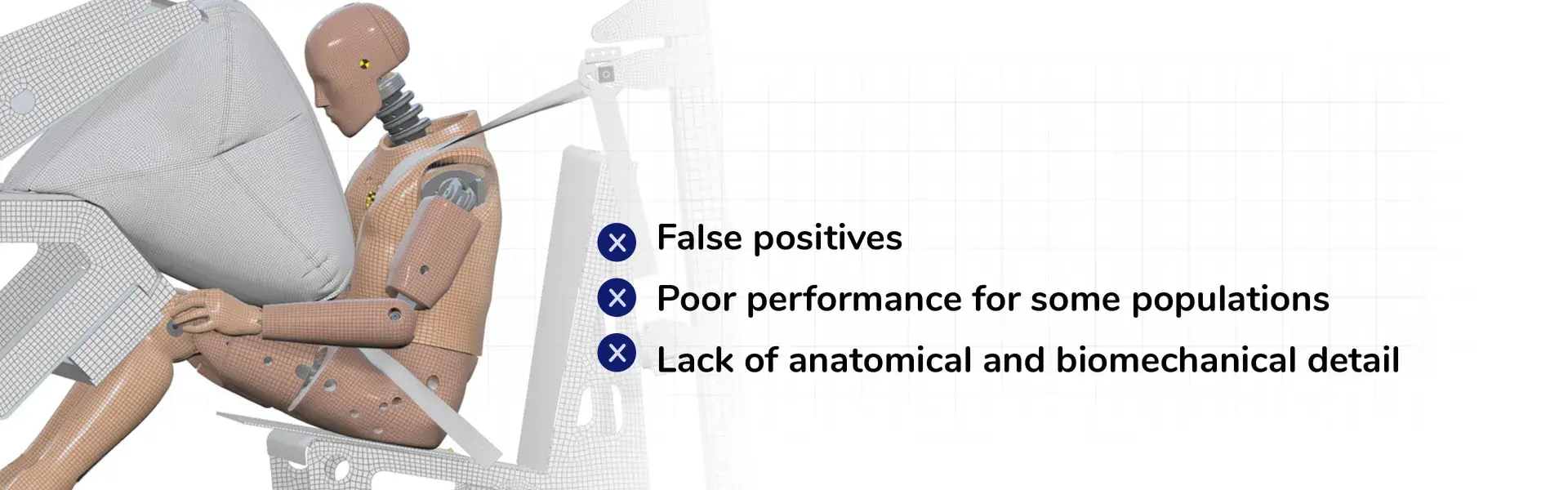
Despite this complexity, many simulation approaches still rely on models that lack sufficient anatomical and biomechanical detail.
The consequences are subtle, but significant.
False Positives
Simulation results may appear valid but fail to capture critical injury mechanisms. Designs may meet regulatory thresholds yet underperform for certain populations. Physical testing must compensate for these false positives that traditional simulation cannot fully address.
As development cycles accelerate, this disconnect becomes harder to manage.
The Solution: Human-Centric Modeling
Humanetics’ digital human body models are built to address this challenge directly.
HBMs are not simplified representations. They are biofidelic, physics-based models. Engineers design them to copy how the human body reacts to forces, motion, and the environment. They do this with high accuracy.
These models enable engineers to evaluate safety at a deeper level by:
- Simulating anatomical structures and tissue response
- Predicting injury based on strain and stress, not just motion
- Representing variability across real-world populations
- Capturing dynamic interactions between occupant and system
This shifts simulation from structural validation to human understanding.
Engineers are no longer limited to asking whether a system performs. They can begin to understand how it affects the human body, and why.
Safety Intelligence in Action: How To Design Beyond the "Average "
Consider a vehicle interior designed for both traditional driving and automated modes.
In automated mode, occupants may recline, rotate, or adopt non-standard postures. These variations introduce new safety challenges that are difficult to evaluate using conventional methods.
With high-fidelity human body models, engineers can simulate:
- Different seating positions and transitions between them
- Variations in body size, posture, and muscle engagement
- The interaction between restraint systems and diverse anatomies
This allows risks to be identified earlier and across a broader set of conditions.
Instead of designing for an "average" occupant, engineers can design for the real population.
This is where Safety Intelligence becomes actionable.
What Makes Humanetics HBMs Different
The effectiveness of any human body model depends on how closely it matches real life. It also depends on how well it fits into the broader safety ecosystem.
Humanetics’ high quality models stand apart in several critical ways.
1: Part of an Integrated Ecosystem (Closed-Loop)
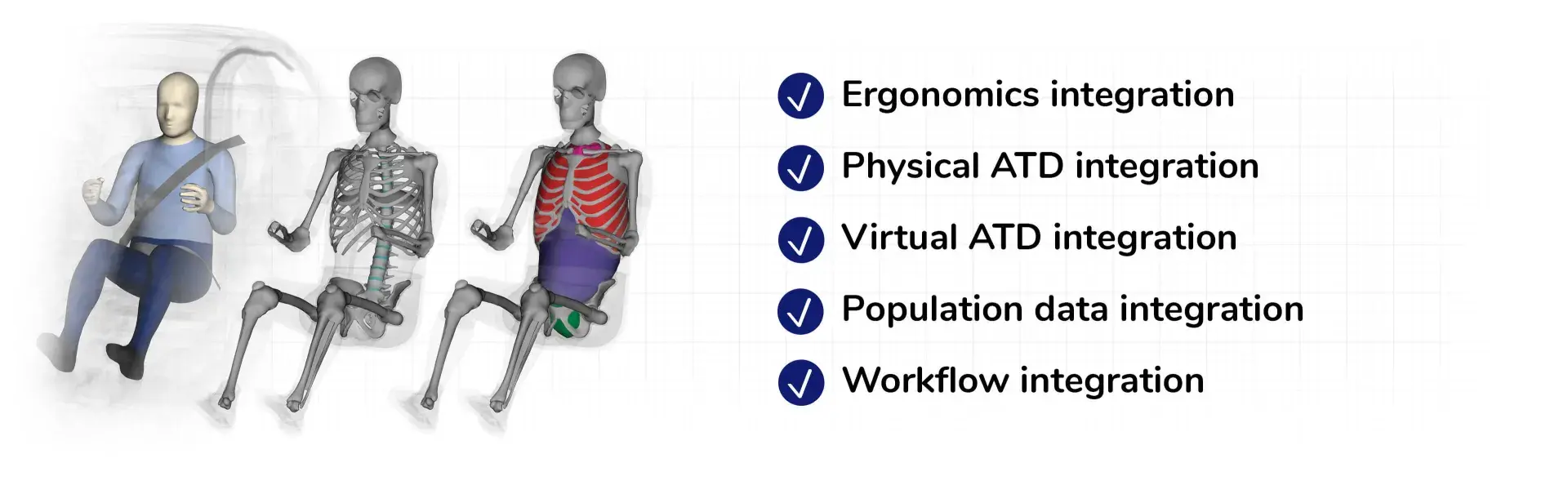
These models do not operate in isolation. They link physical tests, sensor data, and simulation workflows. This creates a closed-loop system where insights improve over time.
Humanetics HBMs integrate with:
- Ergonomics (with RAMSIS or Safety Studio)
- Physical ATDs
- Virtual ATDs
- Population diversity
Automated workflows (with APT CONNECT® and INSIGHT CONNECT®)
2: Grounded in Decades of Biomechanical Research and Physical Testing
Humanetics’ heritage in crash test dummies, sensors, and human measurement provides a unique foundation. The models are not theoretical constructs. They are informed and validated by 75+ years of real-world human response data.
3: High Biofidelity for True Injury Prediction
Rather than relying solely on kinematic outputs, Humanetics HBM models simulate tissue-level response. Engineers can use this to evaluate how injuries occur, not just to determine whether something exceeds a threshold.
4: Designed for Population Diversity
Safety is not uniform, and neither are the people it protects. Humanetics models incorporate variability across gender, size, and physiology, enabling more inclusive and accurate safety design.
This combination of integration, grounding, and fidelity, are what separates Humanetics from competitors.
How Does HBM Help You?
It helps you find risk sooner. It enables you to rely less on late-stage testing, and trust simulation-based decisions more.
Most organizations already use simulation widely. Teams are under pressure to accelerate development, reduce cost, and manage increasing system complexity. Digital tools are in place, but confidence in human response modeling is often limited.
This creates a problem. Existing models may not provide sufficient accuracy or representation. Engineers rely on them for early-stage decisions but must validate extensively through physical testing. This introduces inefficiency and uncertainty.
The implications become clear over time. Development cycles extend because teams discover issues later in the process. Design changes become more costly. Certain risks, particularly those affecting underrepresented populations, may go undetected until late validation stages or even post-launch.
Human body models change this dynamic. HBM enables faster iteration without sacrificing accuracy, and they support the development of systems that perform more consistently across real-world populations.
In doing so, they shift safety engineering from reactive validation to proactive design.
Interested in More Content Like This?
Subscribe to the Humanetics Pulse newsletter to learn more about Humanetics Products, News, and Industry Updates.
From Representation to Prediction
The most significant impact of advanced human body models is the transition from representation to prediction.
Traditional approaches approximate human behavior. High-fidelity models enable engineers to predict it.
This predictive capability is essential in a world where:
- The number of possible scenarios exceeds what can be physically tested
- Vehicle systems are increasingly adaptive and software-driven
- Safety expectations continue to rise
By combining detailed human modeling with scalable simulation, organizations can move from asking:
- “Does this design pass?” to
- “How will this design protect humans in the real world?”
Key Takeaway: You Can Engineer for Real Humans, Not "Averages"
Safety has always been about protecting people.
What is changing is our ability to represent those people accurately within the engineering process.
High-fidelity human body models ensure that simulation reflects the complexity, diversity, and reality of human experience. They enable engineers to design systems that are not only compliant, but truly protective.
Because in the end, the goal is not to design for a test. The goal is to protect someone.
That requires sophisticated virtual models with high biofidelity.
Keep Learning
Learn more about our HBM solutions.
Talk to an Expert
Contact our Human Body Model experts to see how we can help you on your next project.
Frequently Asked Questions
What is HBM / Human Body Modeling?
Human Body modeling is the use of detailed computer simulated representations of the human body. Representations that capture high-fidelity human anatomy. These representations includes bones, muscles, and soft tissue.
Researchers and safety systems engineers use HBM to perform virtual safety simulations. Doing simulation in a virtual environment saves time and money over real-world physical testing.
People use HBM widely:
- Automotive manufacturing processes
- Military
- Medical research
- Ergonomics
Humanetics provides advanced Human Body Models (HBM) for virtual crash simulation and safety assessment, improving vehicle occupant protection strategies. Learn more about Humanetics HBM solutions here.
Why do I need Human Body Models over traditional virtual models?
Human body models can more accurately predict injury by replicating the human bodies structures:
- Skeleton
- Muscles
- Soft tissue / Internal organs
What makes Humanetics Human Body models superior?
Humanetics invented the crash test dummy. This gives Humanetics decades of specialized experience. Our HBMs are:
- Grounded in decades of physical testing data and biocmechanical research
- Have high biofidelty for accurate injury prediction
- Designed for population diversity backed by large datasets
- Are part of an integrated, or closed-loop system. Our tools link together physical testing, sensor data, and advanced simulation workflows.
Humanetics HBMs integrate with:
- Ergonomics (with RAMSIS or Safety Studio)
- Physical ATDs
- Virtual ATDs, and
- Population Diversity (with APT CONNECT® and INSIGHT CONNECT®)

Chirag Shah, PhD, PMP
Chirag is the CAE Product Development Manager, where he leads strategy, planning, and execution for Human Body Model (HBM) initiatives. With more than 16 years of experience in the automotive sector, he specializes in technology integration, project and product management, and cross-functional collaboration, driving innovation in virtual modeling solutions that enhance safety and performance outcomes.