
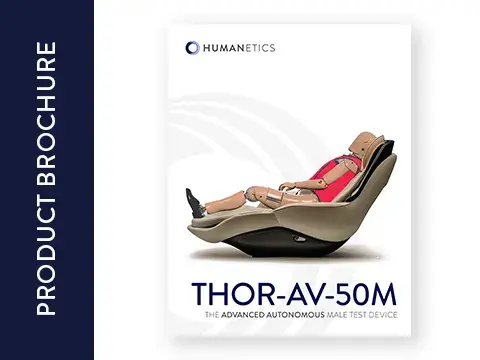
Purpose-built for reclined seating between 25° and 60°, THOR-AV-50M delivers biomechanical insight that empowers safety teams to validate reclined seating with confidence, accelerate development decisions, and stay ahead of evolving global standards.
When seating evolves, safety must follow
Vehicle interiors are changing faster than safety validation tools. Seats recline. Interiors become lounges. Passengers rotate, relax, and disengage from the driving task. What was once a fixed, upright position is now fluid and flexible. But crash testing hasn’t kept pace.
In reclined postures, crash dynamics change completely. The pelvis can slip beneath the lap belt. Crash loads shift into the abdomen and lumbar spine. Airbag timing no longer aligns with forward excursion. Injury mechanisms become asymmetric and three-dimensional. Legacy crash dummies were never designed for this reality. Built for upright seating, they lack the abdominal biofidelity and instrumentation needed to measure these new risks. That leaves engineering teams with blind spots.
And blind spots in autonomous safety are expensive.
Meet the THOR-AV-50M
This next-generation crash test dummy accurately represents human kinematics in upright and reclined positions up to 60 degrees. With 150 high-resolution data channels, it captures detailed biomechanical signals across the head, neck, thorax, abdomen, pelvis, and lower extremities.
THOR-AV-50M delivers measurable clarity where legacy crash test dummies cannot.
Advanced Biofidelic Enhancements for Reclined Seating
Reclined postures increase lap belt angle, shift load paths toward the abdomen, and change how the body moves in a crash. The THOR-AV-50M introduces targeted upgrades to better replicate human-like kinematics and address the unique challenges of reclined seating in autonomous vehicle environments.

1. Biofidelic Neck
The THOR-AV-50M neck is more advanced with improved flexion and extension response. This provides a more biofidelic head and neck movement, supporting more reliable injury prediction.
2. Enhanced Rib Instrumentation.
Provides detailed chest and thoracic load measurements, allowing engineers to fine-tune restraint strategies with greater confidence.
3. Molded abdomen with integrated Abdomen Pressure Twin Sensors (APTS).
The modeled abdomen with integrated APTS enables engineers to get precise measurements of abdominal pressure and injury risk, providing defensible data when evaluating restraint systems.
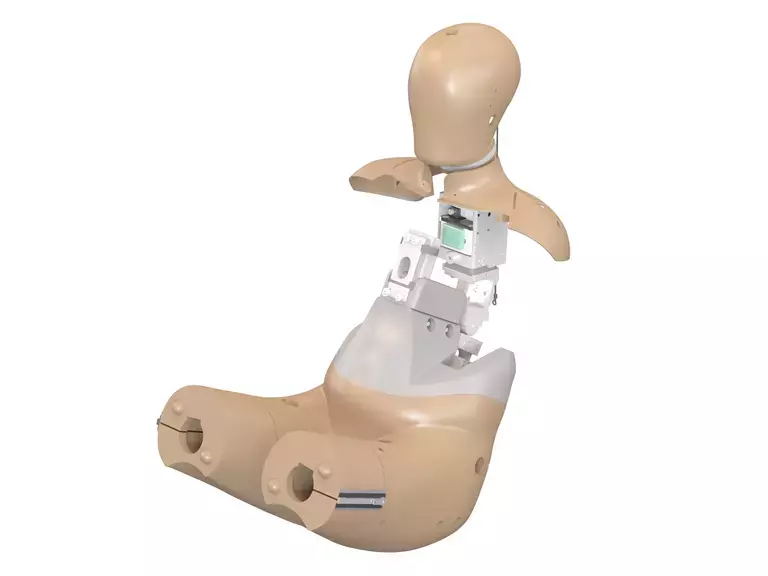
4. Longer, circular lumbar spine.
Better replicates human torso motion in reclined seating, improving the accuracy of forward excursion and overall kinematic response.
5. Pelvic bone geometry with representative coccyx and ischium structures.
The updated pelvic bone geometry represents the coccyx and ischium structures, which improve belt-to-body interaction and help identify submarining risk earlier in the event.
7. Softer pelvic flesh.
Creates more realistic lap belt loading, leading to more accurate assessment of belt performance and abdominal load paths.
These aren’t small upgrades. They’re purpose-built features designed to deliver realistic biofidelity in reclined crash conditions. The result is more accurate HIC, Nij, and chest deflection data. That means better calibration of multi-stage airbags, far-side airbags, and seat-integrated restraint systems. Instead of estimating airbag timing for reclined occupants, you can engineer it with confidence.
Engineering Confidence Into Every Test
Modern safety validation is both physical and digital. When virtual crash test dummy models are fed incomplete pelvic and abdominal data, simulations can look safer than reality. That leads to late-stage surprises.
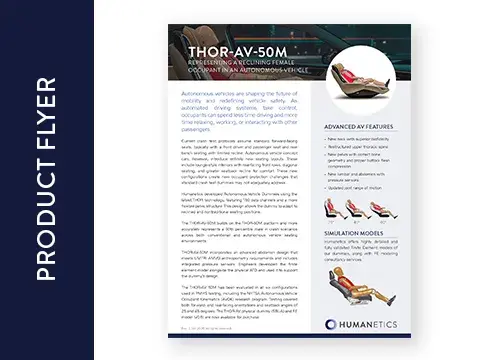
The THOR-AV-50M strengthens digital-to-physical alignment with richer abdominal and thoracic data channels. Calibrated FE models are available in LS-DYNA and PAM-CRASH , helping your team reduce prototype loops early in the program.
It also reduces litigation exposure. High-fidelity, defensible biomechanical data strengthens your position when validating novel AV seating architectures .
With the THOR-AV-50M specified for upcoming C-IASI 2026 reclined seat regulations, you are not just compliant. You are prepared. This is risk mitigation at the engineering level.
The new benchmark for reclined seating
The THOR-AV-50M is not a refinement of legacy testing. It is the benchmark for autonomous interior validation

Purpose-Built
Engineered specifically for torso angles up to 60 degrees.

Realistic Biofidelity
Advanced pelvic bone geometry and integrated abdominal pressure sensing for accurate submarining detection

Digital-Twin Integration
Validated virtual crash test dummy models available for leading simulation platforms.

Regulatory Readiness
Aligned with emerging global reclined seating standards.
SPECIFICATIONS
Standard ATD 478-0000-PR
| OVERALL DIMENSIONS | 1094.9 x 486.8 x 1132.0 mm | 43.1 x 19.2 x 44.6 in |
| TOTAL WEIGHT | 76.6 kg | 168.9 lb |
| SEATED HEIGHT | 886.5 mm | 34.9 in |
Key Features
THOR-50M Base Dummy with:
- Head accel and slice mounting modifications
- Updated joint range of motion
- Neck with enhanced biofidelity
- Updates to lumbar spine, pelvis, and abdomen
- Design is unique to Humanetics
Technical & Research Publications
- Wang et al. 2021 IRCOBI, Neck biofidelity comparison of THOR-AV, THOR and HIII 50th dummies.
- Wang 2022 SAE Biomechanical responses of the THOR-AV ATD in rear facing test conditions
- Wang et al. 2022 IRCOBI, THOR-AV 50th percentile male biofidelity evaluation in 25° and 45° seatback angle test conditions with a semi-rigid seat
- AVOS Consortium, 2023 ESV, Investigation of the biofidelity of human body models and ATD models in sled test conditions
Model Options
Applications
- Proposed for usage in all current applications of the THOR-50th Male
- Offers enhanced biofidelic response and instrumentation capability
Regulations
For a full list of model regulations, please contact a member of the Humanetics team.
Instrumentation
| LINEAR ACCELEROMETERS | ANGULAR RATE SENSORS | LINEAR ACCELEROMETERS | TILT SENSOR | ANGULAR ROTATION TRANSDUCERS | LOAD CELLS | LOAD CELLS | LOAD CELLS | PRESSURE SENSORS |
|---|---|---|---|---|---|---|---|---|
| Head Axyz, Axyz | Head ωxyz | Head Θxy | Neck Θy | Facial 5X Fx | ASIS L/R 2X Fx, My | Lower Tibia Fxyz, Mxy | Abdomen -APTS L/R, P, P each | |
| Thorax T1 Axyz | Thorax (3) ωxyz, ωxyz, ωxyz | Upper Thorax L/R Dxyz (ea. side) | Lower Thorax Θxy | L/R Ankle Θxyz (ea. side) | Upper Neck Fxyz, Mxyz | Acetabulum L/R Fxyz, Fxyz | Achilles L/R Fz, Fz | |
| Pelvis Axyz | Pelvis ωxyz | Lower Thorax L/R Dxyz (ea. side) | Upper Lumbar Θxy | Upper Thorax Fxyz, Mxyz | Upper Leg L/R Fxyz, Mxyz | |||
| Tibia L/R Axyz | Tibia Displacement L/R Dx (ea. Side)- | Lower Torso Θxy | Upper Arm L/R Fxyz, Mxyz | Upper Tibia Fxyz, Mxy | ||||
| Foot L/R Axyz | Foot L/R ωxyz | Foot L/R Θxy |
Move Forward with Confidence
Reclined seating is no longer experimental. It is becoming standard in autonomous mobility architectures. The question is not whether validation requirements will evolve. They already are. Equip your safety engineering team with the tool designed for this new reality.
Contact us to request technical documentation, pricing, or a live demonstration of the THOR-AV-50M.