
Automotive safety engineering has never been faster or more data driven.
Modern virtual crash simulations help CAE engineers test thousands of crash scenarios before a physical prototype exists. Advanced occupant models, detailed restraint systems, and expanding regulatory protocols have dramatically increased the industry's ability to test safety performance virtually.
But there is a new bottleneck.
The problem isn't simulation capacity. Now, it is understanding the results and making good product design decisions. We're drowning in data.
In this article, we'll explain how to make use of your crash data in the face of evolving NCAP challenges.
The Challenge: Increased Data Generation is Outpacing Insight
Across the automotive industry, safety teams are generating more crash simulation data than ever before. Interpreting that data has become one of the most time-consuming and uncertain steps.
Engineers often spend days or even weeks analyzing data. We read signal curves, estimate load paths, and run new design iterations. We use our best engineering judgment to find the right parameter or parameters. We hope to bring the injury value below its threshold.
The challenge is not running simulations. The challenge is turning simulation data into data-driven, confident engineering decisions. After that, the goal is to turn data into design improvements with minimal iterations.
INSIGHT CONNECT® solves these challenges.
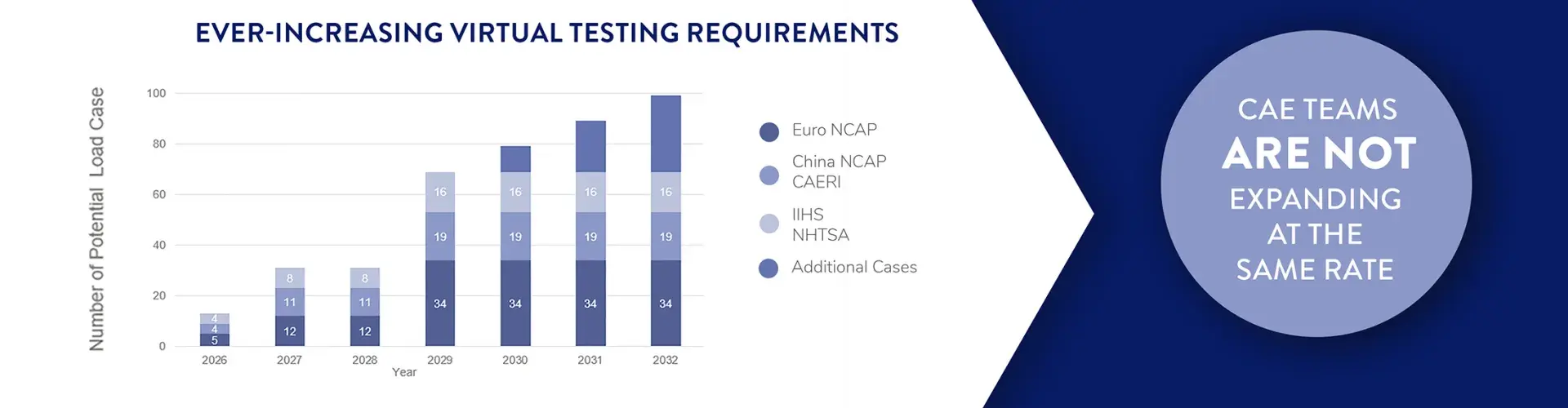
How We Got Here: More Requirements
The automotive industry has embraced simulation to accelerate vehicle development. There are:
- New regulatory scenarios that focus on virtual testing (VT)
- New regulations that will multiply simulations (workload will increase by 2.5-3x in coming years)
- Evolving NCAP compliance protocols which are divergent in nature, and now expand to include Human Body Models (HBMs)
- HBMs that increase the number tests cases engineers must evaluate
This is good. It allows engineers to avoid failures during an expensive physical test.
By the end of the decade, many safety programs may analyze several times more crash scenarios than they do today.
CAE engineering teams are not expanding at the same rate. We're not ready to deal with the 5x increase in workloads driven by the VT requirements.
This imbalance has created a critical gap. Crash data analysis still depends too much on manual work.
The Solution: Turning Data into Engineering Clarity
INSIGHT CONNECT® transforms how engineers interact with crash simulation results.
Instead of manually interpreting dozens of signal curves, the platform organizes crash data. Data points become a clear analytical workflow. CAE engineers get detailed insights to accelerate root cause analysis.
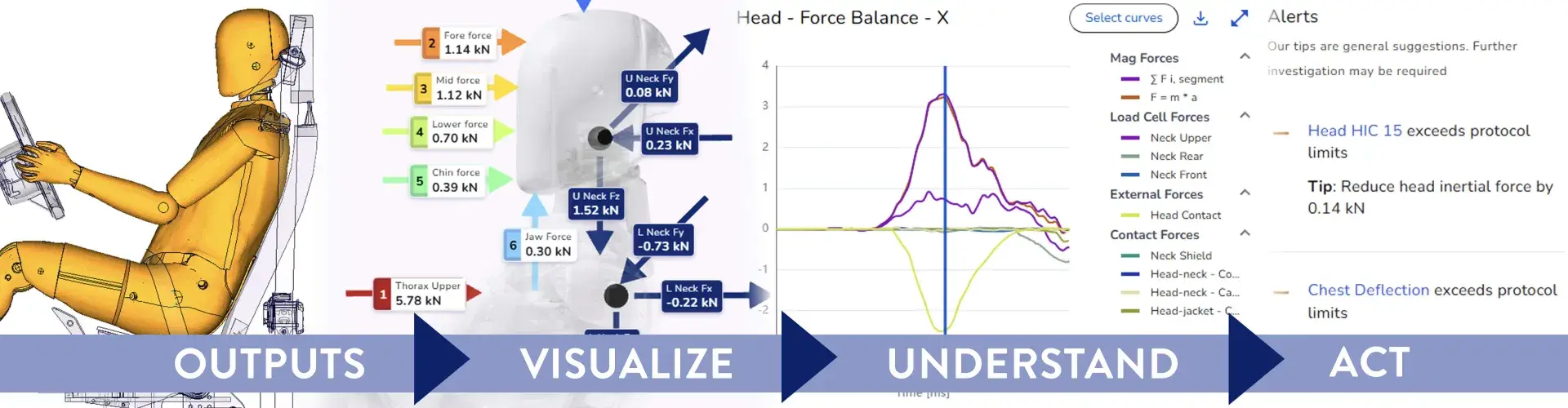
The system operates around four core principles.
1: INSIGHT CONNECT® Dummy Outputs
Standard post-processing extracts the regular channels required to compute injury criteria. These are the outputs engineers have always worked with. However, by definition, they are insufficient for root cause diagnosis.
INSIGHT CONNECT® Dummy Models resolve this by making non-standard outputs available deterministically. The diagnostic question shifts:
- From how bad the injury value is
- To why this force exists, at this magnitude, at this time, on this body region
2: Visualize
Engineers can see how loads propagate through different body regions during the crash event. Decompose force contributions by source over the crash time. This visualization transforms abstract signal data into intuitive insight. The interaction between restraint geometry and occupant kinematics is no longer inferred; it is computed.
3: Understand
First, INSIGHT CONNECT® analyzes the force balance within the model. Then, it identifies which body regions contribute most to a specific injury response. Engineers can trace injury values back to their physical cause. You won't need trial-and-error analysis.
4: Act
A decision dashboard highlights injury exceedances, identifies the source of force overload on the affected body region, suggests target force-reduction values, and helps engineers re-evaluate restraint system improvements using dashboard insights.
By structuring crash analysis around these steps, INSIGHT CONNECT® turns simulation output into actionable engineering intelligence.
Ways to Make Better Use of Your Crash Data
Every crash simulation creates hundreds of standard signals that describe the motion and forces on occupant surrogates. Engineers must determine:
- Why an injury criterion exceeded its threshold?
- Which design parameters are responsible?
- What design change will correct the issue?
- Can we confidently suggest a countermeasure that will actually protect the occupant ATD?
Without non-standard outputs that reveal unknowns and offer deep insights and clear diagnostic tools, this process becomes iterative. Gut feelings and increased reliance from juniors on experts help drive engineers. The result is what many safety engineers describe as the "iteration trap".
Interested in More Content Like This?
Subscribe to the Humanetics Pulse newsletter to learn more about Humanetics Products, News, and Industry Updates.
Avoid the "Iteration Trap"
Designing an optimized restraint system is rarely straightforward.
Airbag timing, pretensioner timings, belt loads, seat stiffness, and occupant kinematics interact in complex ways. A small adjustment intended to improve one injury metric can worsen another. You may suddenly miss metric for a different NCAP protocol.
Engineers rely on trial and error. Without clear insight into load paths, force transfer in the body, and the exact size of critical parts, you must keep iterating.
The process typically looks like this:
- A simulation estimates an injury exceedance
- Engineers analyze dozens of signals to determine the cause
- Design changes are implemented
- The simulation is rerun
If the problem persists, the cycle continues.
Diagnosing the root cause of an NCAP exceedance using traditional methods can take up to two weeks.
But schedule delays are only part of the problem. Without a first-principles force balance, even skilled engineers rely on patterns and past experience. That is structured guesswork, not computation.
This is not a failure of expertise. This is a structural limitation of the existing method. A single late-program NCAP physical test failure can cost $150,000 to $350,000 per test, plus delay launch schedules.
Reduce Analysis, Increase Insight
If you improve your crash data interpretation, you get time and the decision-making edge.
Traditional crash simulation analysis often requires extensive manual investigation, and expert engineers reduce the margin of decision-making error. Engineers compare signal curves, study occupant motion, and test many design options. They do this to find the cause of an injury exceedance.
INSIGHT CONNECT® automates much of this diagnostic process.
Force vector visuals and body-region load analysis help engineers find the main cause of safety issues much faster. With dashboard intelligence, teams can reduce analysis time from weeks to hours in many cases.
Across a full vehicle development program, these time savings can translate into weeks or months recovered in engineering schedules.
Scale Engineering Expertise Across Your Teams
As safety programs grow in complexity, another challenge is emerging. The industry faces a widening talent gap.
Senior safety engineers often spend significant time mentoring junior engineers on how to interpret complex crash signals. At the same time, less experienced engineers may struggle to diagnose the underlying mechanisms behind injury metrics.
INSIGHT CONNECT® helps bridge this expertise gap.
The platform enables engineers at all experience levels to understand crash behavior more quickly. It does this by:
- Visualizing crash dynamics and
- Automating root cause diagnosing

Junior engineers gain the ability to diagnose safety issues in minutes rather than weeks. Senior engineers gain time to focus on innovation and system optimization.
In effect, the platform helps scale expert knowledge across the entire safety organization. As safety simulation becomes central to vehicle development, the ability to interpret crash data quickly is becoming a competitive advantage.
Turn Crash Data to Competitive Advantage
Vision Zero calls for protection across a much wider design range than today’s vehicle programs cover. It includes more diversity in occupant size, shape, and seating posture. It also covers a wider range of crash severities and impact scenarios.
Restraint systems that perform only within a narrow band of conditions will not be enough. The only scalable engineering response is to shift to virtual development, where simulation becomes the main development tool.
But that shift comes at a price. Expanding coverage rules increase load cases, occupant changes, and design revisions. This creates huge simulation data that can overwhelm older analysis workflows. Designers did not build those workflows to handle it.
The future of safety engineering will not depend on how many simulations teams can run.
Their speed in converging the data to resolve issues and optimize the designs will define it.
By transforming virtual crash simulation data into clear engineering insight, INSIGHT CONNECT® helps safety teams:
- Accelerate NCAP compliance validation
- Perform faster root cause analysis
- Reduce costly iteration loops in restraint development
- Improve collaboration across safety engineering teams
- Deliver safer vehicles to market faster
In a development environment where complexity continues to grow, clarity becomes a strategic advantage. INSIGHT CONNECT® helps engineers achieve that clarity.
Key Takeaway: A Smarter Path to Automotive Safety
Crash simulation will only become more powerful by transforming data driven insights into confident decisions more quickly.
The real opportunity lies in making the results easier to understand.
INSIGHT CONNECT® represents a shift in safety engineering. The process moves from manual interpretation toward intelligent, data-driven decision making.
Early users of INSIGHT CONNECT® have already seen measurable improvements. A major OEM recently told us:
“The time to analyze injury results is down 32-44%! This is for expert and junior engineers using this solution for several months.”
A principal safety engineer highlighted the clarity the platform brings to complex crash data:
“The views are clear and intuitive. They not only help document results but also make it much easier to explain crash behavior to colleagues.”
Safety teams are working to deliver five-star performance. They're doing this under increasing regulatory pressure. How fast you learn from your data can mean the difference between chasing results and engineering them with confidence.
When engineers understand the first simulation faster, they can design safer vehicles sooner.
Keep Learning
We have more resources for CAE engineers and our team is standing by to answer your questions.
Talk with an Expert
Discover how INSIGHT CONNECT® can help your team save up to 96 days of work. Pinpoint injury causes faster. Ensure regulatory compliance.
Frequently Asked Questions
What is CAE?
CAE stands for Computer-Aided Engineering. In safety engineering, engineers use CAE software tools to run simulations, validate issues, and improve product designs all before a physical mockup or prototype is created. Humanetics provides CAE tools like INSIGHT CONNECT® to optimize testing workflows and improve data analysis in virtual crash test dummy simulations.
What is NCAP?
NCAP stands for New Car Assessment Program. It’s a global safety rating system that evaluates vehicle crashworthiness and safety features through standardized crash tests and performance assessments. It provides safety ratings to help consumers make informed decisions and encourage manufacturers to enhance vehicle safety.
Learn more about the Global NCAP Program - https://www.globalncap.org/about
Global NCAP programs include:

Apoorva Lakshminarayana
Apoorva is the CAE Product Manager at Humanetics, where he oversees the development and integration of advanced digital human models used in virtual testing and safety simulation. Before stepping into this role, he served as Lead Project Manager, responsible for the development of child and side impact dummy models, contributing to key innovations in occupant safety. With a strong background in computational modeling and biomechanics, Apoorva focuses on bridging physical testing and virtual validation to advance the accuracy and efficiency of safety system development.