
In safety engineering, small differences can produce vastly different outcomes.
- A few millimeters in dummy posture
- A slight change in pelvis angle
- A different reference point in seat positioning
These subtle variations can change dummy kinematics. They can also alter restraint system performance. Variations influence how forces move through the body. They can affect injury metrics, prevent repeatable tests, and undermine the confidence engineers have in their results.
Despite decades of progress in safety technology, occupant positioning often remains disconnected across the development process.
- Crash test laboratories position hardware dummies physically.
- CAE teams recreate that position with virtual dummy (or human body models)
- Vehicle architecture design teams define occupant position and interior layout inside CAD environments.
Each step depends on accurate positioning. But the data rarely flows smoothly between them.
In this article, we'll explain how Humanetics solves this challenge through a closed-loop positioning workflow. We connect physical testing, simulation, and design using standard definitions across platforms and transferring common positioning data.
The Problem: Disconnected Positioning Workflows
When occupant positioning does not move consistently across design, simulation, and physical testing, the impact goes beyond being inefficient.
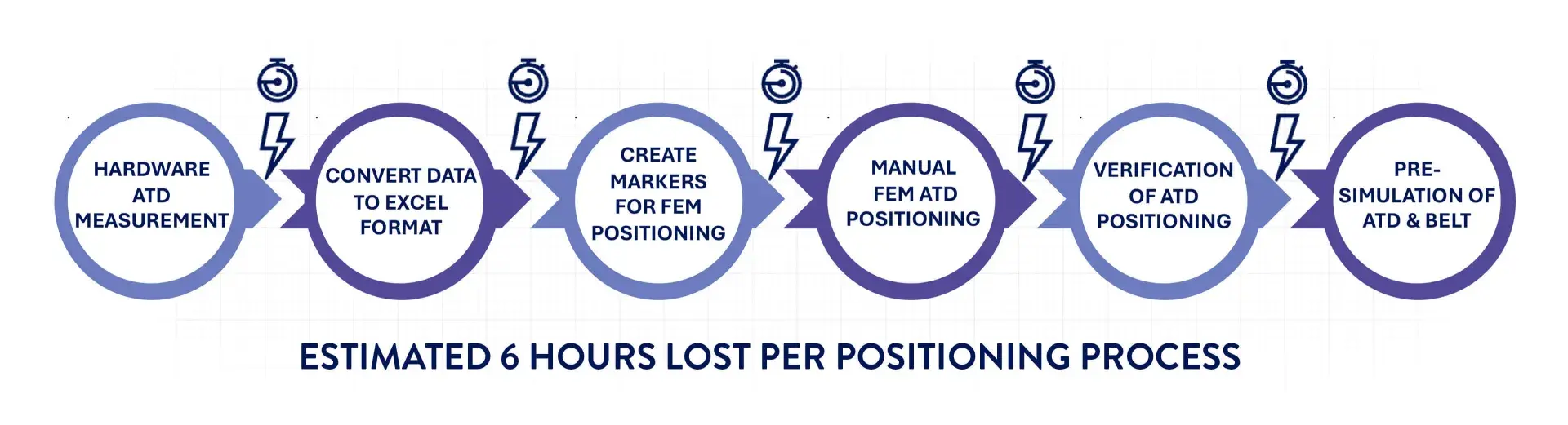
Engineering teams must recreate positioning data again and again. Instead, they could be building on a shared foundation. This introduces variation between workflows, increases dependence on individual judgment. As a result, safety may be designed on setups that do not fully reflect the original ergonomic design intent.
In some cases, teams discover this misalignment late in development. Final tests or validation then show needed changes. These changes may negatively affect the vehicle interior, restraint setup, or occupant package.
By then, the consequences are significant: added effort, costly rework, increased development cost, and program delay.
What is missing is not another isolated tool. You need a common positioning framework. One that allows accurate data to flow across the entire vehicle design workflow.
The Solution: A Closed-Loop Between Test, Simulation, and Design
Humanetics is addressing this challenge through a closed-loop approach to dummy positioning that connects three environments:
- Physical crash
- Virtual crash / CAE
- Safety design / CAD
The concept is simple: positioning data should move freely. It needs to be easy for engineers to reproduce the same occupant configuration throughout the development process.
In this workflow:
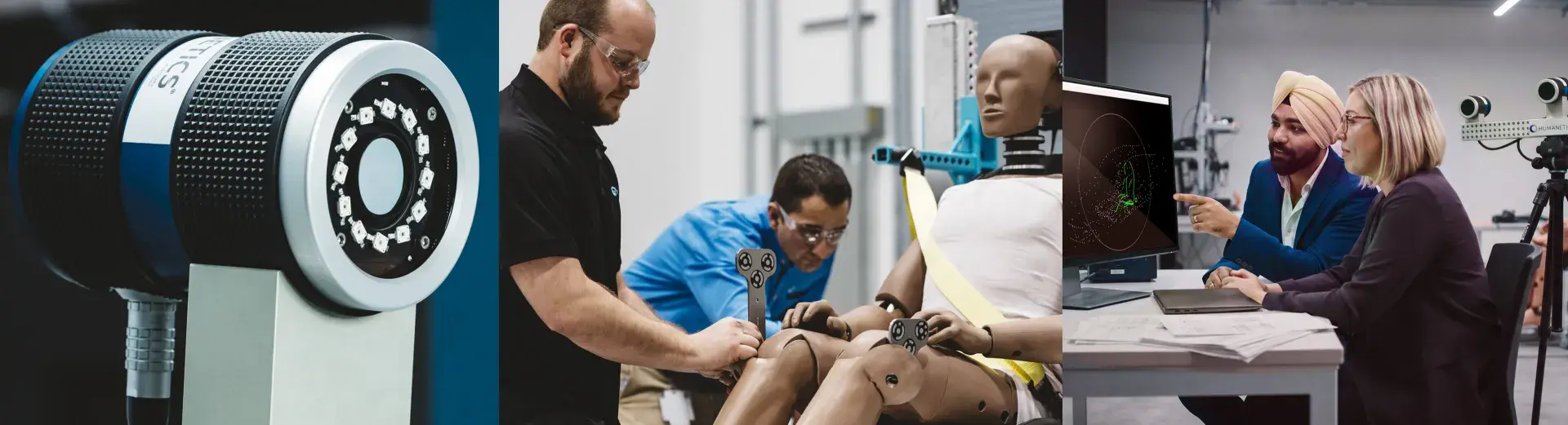
- The Dummy Positioning System (DPS) cameras capture and display 3D metrology data in real-time during positioning
- DPS Studio helps you evaluate then transfer data for further use
- Safety Studio evaluates occupant posture within vehicle interior design environments using the same CAD geometry of Crash Test Dummies
- APT Connect® applies that positioning to crash simulation models
Together, these solutions create a continuous loop of positioning data across the safety development lifecycle.
Positioning data flows between crash test hardware, CAE simulation, and safety design tools. This creates common positioning data loop (the closed-loop).
The Dummy Positioning System
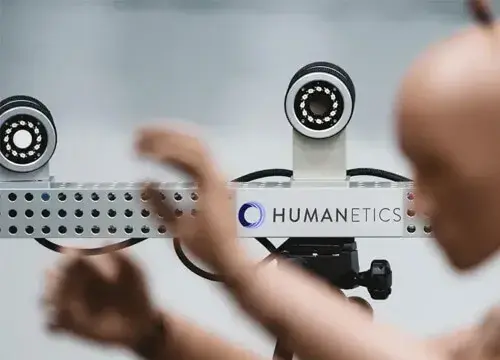
Our Dummy Positioning System (DPS) is a camera-based coordinate measuring machine (optical CMM). Unlike other traditional CMM systems, Humanetics DPS is fully mobile and portable.
- High-resolution digital cameras packaged in an industrial housing
- Works according to the photogrammetric principle
- ActiveProbe (cable loss, handheld) with interchangeable probe tips for alignments, tactile single point measurements, and contour scanning
- Dynamic referencing functionality optimizes workflows and avoids time consuming realignments
- Dummy adapter kits for real-time positioning of dummy points
- Software control with graphical and numerical readout
- Fully mobile and portable
- Modular system that is expandable for new tasks
Tips For Better Occupant Positioning in Your Safety Engineering
The benefit of a closed-loop workflow is simple but powerful. Here are some tips that can help your team.
1: Reuse Positions, Don't Recreate Them
Instead of recreating occupant positions manually in each environment, engineers can reuse verified positioning data across physical and virtual workflows.
For example:
- A safety engineer may begin by evaluating seating configuration in Safety Studio during vehicle design.
- You can then transfer that configuration to CAE using APT Connect® to run crash simulations and design restraint systems.
- Once you validate the design, you can use the same positioning definition for real world crash tests.
- The positioning information remains consistent across all three environments, without risk of a position error.
This consistency reduces uncertainty and helps ensure that simulation results, physical tests, and design analyses align.
2: Build a Common Positioning Language
Achieving this level of integration requires more than simply connecting software tools.
It requires a common technical framework for positioning data.
For example, the positioning workflow uses shared posture transfer data. This data lists key markers, coordinates, and orientation angles. It helps define the dummy posture.
To support accurate data exchange:
- Dummy marker definitions must be consistent between hardware, CAE models, and CAD environments
- Positioning data must use the same coordinate definitions
- Posture information must be represented in a common format that all tools can interpret
These elements are the foundation of a common positioning language. It helps positioning data move reliably through the development process.
Interested in More Content Like This?
Subscribe to the Humanetics Pulse newsletter to learn more about Humanetics Products, News, and Industry Updates.
3: Integrate Isolated Tools
Rather than delivering isolated tools, the goal is to create an integratedsystem. This adds value across your safety development ecosystem.
Individually, each product provides significant capability:
- The DPS optical-based 3D metrology system improves accuracy and repeatability of dummy positioning for the physical testing
- APT Connect® accelerates occupant model preparation for crash simulations
- Safety Studio enables engineers to evaluate occupant posture and safety concepts during vehicle design
When connected together, however, the value multiplies.
Positioning data captured in one environment can directly inform the next step in the development process.
This integration reduces duplication of effort. It also creates a consistent foundation for safe evaluation.
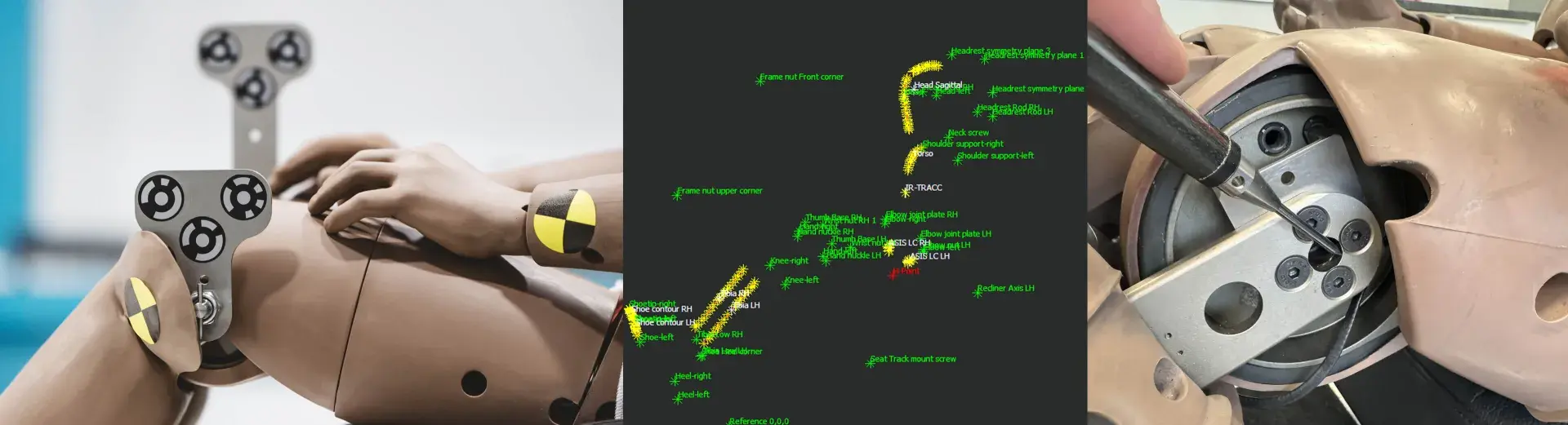
Left: DPS position markers | Center: DPS Studio displaying point data | Right: DPS probe tip
Key Takeaway: A New Way to Connect Safety Development
As vehicle safety development becomes increasingly complex, integrated data across tools and disciplines will be essential.
When positioning data moves smoothly between test, simulation, and design, safety development becomes more consistent, efficient, and reliable.
Talk to an Expert
Contact our safety experts to see how we can help you on your next project.
Frequently Asked Questions
What is a closed-loop solution?
In the context of safety engineering, a closed-loop system or solution seamlessly connects physical and virtual testing. A safety certification test uses a physical dummy to generate data. This data feeds into a real-time digital twin of the dummy.
A “closed loop” can allow faster and more accurate virtual testing scenarios. This enables better analysis, faster improvements, and smarter decision making.
What is a CMM / coordinate measuring machine?
A CMM (coordinate measuring machine) is a device that measures precise 3D data (X, Y, Z axis). In safety testing, engineers can use a CMM to "link" their physical and virtual crash test dummies. It enables accurate positioning.
What is the DPS / Dummy Positioning system?
The Dummy Positioning System (DPS) is a camera-based coordinate measuring machine (optical CMM). Unlike other traditional CMM systems, Humanetics DPS is able to measure and track multiple points simultaneously. It includes DPS Studio Software for evaluating and transferring data. Part of a complete closed-loop solution for safety testing with Safety Studio and APT Connect®.

Dr. Anurag Soni
Dr. Soni is an experienced Product Manager at Humanetics Innovative Solutions. He leads the development of advanced digital products that drive innovation in automotive safety and biomechanics. Anurag has over 20 years of experience in occupant safety research and product development. He's contributed to the development of Human Body Models (HBMs) that are now widely used all over the world. His expertise spans HBMs, restraint system design and virtual testing solutions. He's passionate about innovating digital safety and committed to protecting people.