

Barney Loehnis - July 03, 2026
Great engineering never goes out of style. It remains as inspiring as the day it was created.
For generations, humanity has looked at engineering feats with a sense of awe, drawn not only to what technology can do, but to what it represents for humankind: our progress, our triumph over impossible dreams, and the enduring belief that, no matter the size of the challenge, we can build a better world. At its best, engineering is transformative: an elegant fusion of science, creativity, and purpose – where ingenuity meets responsibility, and where optimism takes form.
Celebrating 75 Years of Engineering that puts Humans at the Center of Innovation
For 75 years, Humanetics has stood at the intersection of Purpose, Engineering, and Ingenuity.
From the unmistakable crash test dummy, an enduring symbol of safety, to advanced anthropometric data, digital human modeling, and intelligent sensing technologies, Humanetics has helped shape the systems that protect and enable human life. Every car on the road today carries the imprint of this legacy. Yet our impact extends far beyond automotive safety into healthcare, aerospace, energy, and the critical systems that power and connect the modern world.
This series of posters celebrates that legacy - and the future it continues to build. Borrowing from the classic artwork of Art Deco movementin the 1920s and building on the strength of iconic graphic communications in the pre-digital era.
Timed to coincide with the 250th anniversary of the United States, a nation shaped by diversity, ingenuity, and relentless forward motion, this Humankind initiative reflects a shared spirit of progress. It is a moment to recognize not only technological achievement, but the people behind it, the engineers, designers, and innovators who continuously push boundaries in service of human well-being.
At the heart of the campaign is a series of visually striking posters, echoing the iconic imagery of world fairs and industrial exhibitions of the 1920s and beyond. These works reimagine that era’s celebration of progress through a contemporary lens, showcasing how Humanetics’ solutions contribute to a safer, smarter, and more inclusive world.
Each poster tells a story: of protection, of precision, of partnership. Of technology designed not for its own sake, but in service of people. Because innovation, at its core, is an act of optimism. It creates hope. It builds trust. It reflects a belief that through collaboration, discipline, and imagination, we can improve the human condition.
As Humanetics looks ahead, this campaign is both a reflection and a declaration: Engineering excellence is not just about what we create but why we create it. And progress is only meaningful when it protects, empowers, and elevates human life. This promise is at the heart of Humanetics and our purpose in the world.
Explore 75 Years of Innovation
Click the posters below to read more about how Humanetics has built technology in the service of people.
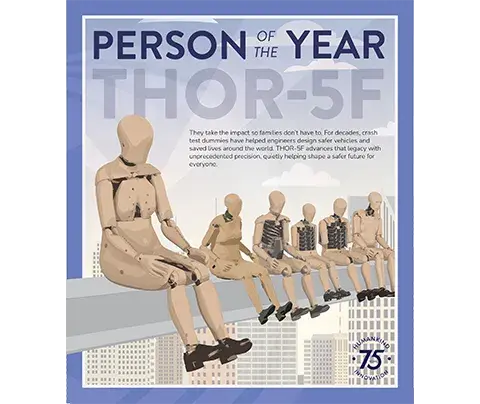
So, THOR-5F is our PERSON OF THEY YEAR.
Which is funny, because crash test dummies don’t talk, don’t smile, and definitely don’t ask for attention. But for decades, they’ve been core to the most important human story in engineering: how we learn to protect each other better.
THOR-5F matters because for a long time, safety testing didn’t fully reflect women’s bodies or women’s injuries. A true female crash surrogate is needed because women are 80% more vulnerable to injury in the abdomen and lower legs, yet many older crash test systems still miss those areas entirely. The old dummies still used in USA regulations have ZERO sensors in the face, abdomen and legs where injuries are suffered.
That’s what makes this dummy such a big step forward. When regulated, THOR-5F, which is instrumented with hundreds of precision sensors to detect injury risk, will help engineers save thousands of lives, and prevent severe injury for millions of women each year.
A new anthropomorphic test device, built so that our mothers, sisters, daughters and wives make it home safely.
Safety is for every BODY. Not just the driver. Not just the average adult. Everybody.
The people we love most are out there living ordinary, beautiful, everyday life. Driving home after dinner. Crossing the street after school. Riding to work before sunrise. Heading out for a weekend adventure.
Real people. Real lives. Real moments that matter. That’s what safety is actually about.
Because nobody plans for the moment they need protection. But when that moment comes, safety should already be there, quietly doing its job for every BODY, everywhere.

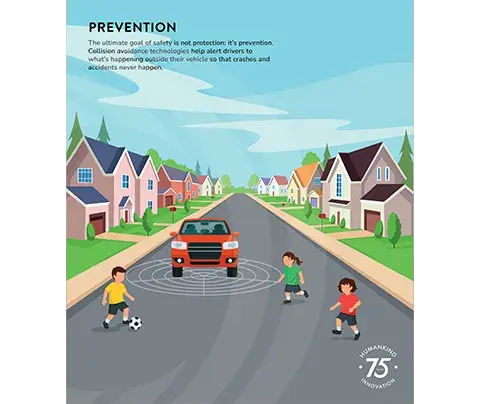
The best crash might be the one that never happens at all.
That’s what makes this moment in safety feel so incredible. Cars are starting to do something that once felt impossible: notice danger before humans do.
Technologies like Automated Emergency Braking can sense risk, react in milliseconds, and help prevent accidents before impact ever occurs.
Quietly. Constantly. Almost invisibly.
It’s a new chapter in safety, where the goal isn’t just surviving the crash. It’s helping make sure the crash never happens in the first place.
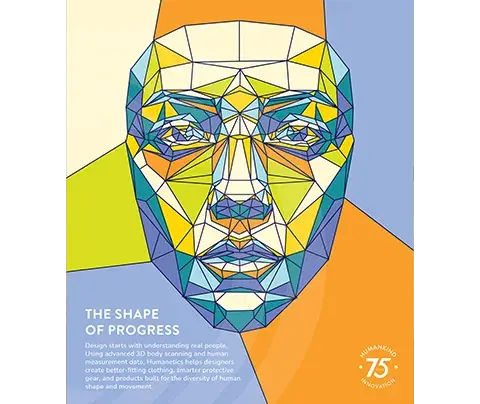
Good design starts with paying attention to real people.
Not the “average” person. Not a perfect measurement on a chart. Real humans, with different bodies, movements, shapes, and needs.
That’s why advanced body scanning and digital mapping matter so much. They help us understand thousands of real human forms in ways we never could before.
And that understanding changes things. Protective gear can fit better. Products can move more naturally with the body.
Because when we design for real human diversity, we don’t just make things more inclusive, we make them better for everyone.
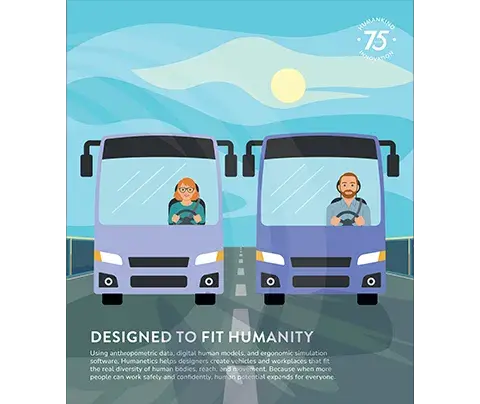
Good design shouldn’t force humans to adapt to the tools around them. The tools should adapt to us.
That’s the science of ergonomics. And it's why Humanetics' anthropometric data, digital human models, and ergonomic software help designers build for every BODY. The idea that design can open doors for more people simply by understanding how real bodies move, reach, sit, work, and interact with the world.
Take the driver’s seat of a school bus. Every button, mirror, pedal, and control matters when dozens of kids are depending on the person behind the wheel.
Design has to work for the tall driver, the shorter driver, the broad-shouldered driver, the driver with smaller hands. Not just one “average” person who barely exists in real life.
Because when design works better for humans, more humans get the chance to step forward with confidence.
Engineering shouldn't limit potential. It should expand it.
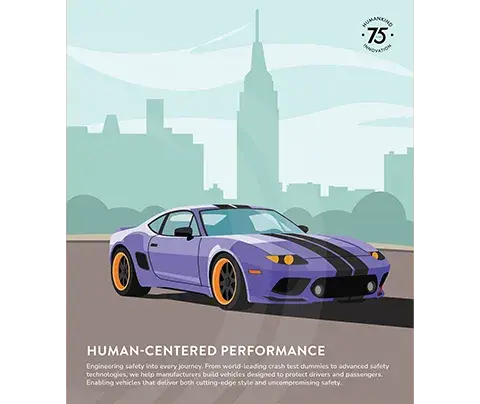
The future of mobility won’t just be defined by speed, autonomy, or technology. It will be defined by how well we protect human life.
That future depends on data most people will never see. Tiny measurements happening deep inside the systems around us. Weight. Size. Seating position. Split-second information helping engineers understand vehicle performance and human response in the real world.
At Humanetics, advanced crash test dummies, active safety testing platforms, and simulation technologies help manufacturers measure how the human body experiences impact, motion, and risk.
These innovations are helping shape a future where mobility performs smarter, reacts faster, and protects people more effectively.
The best innovation doesn’t choose between safety and experience.
It delivers both.
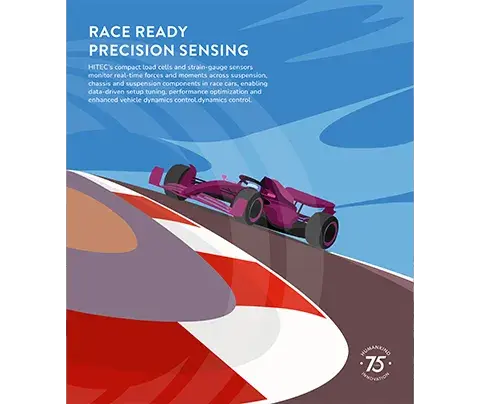
At high speeds, there’s no room for guesswork.
When car speed doubles, the force on the vehicle and driver quadruples. Load sensing in motorsport captures real-time data under extreme conditions, helping teams push performance while maintaining control.
What’s proven on the track often shapes what’s possible on the road. Makes sense.
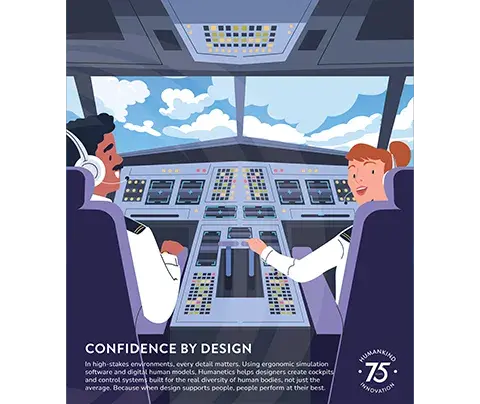
In high-stakes environments, design shapes control.
Every instrument, every display, every line of sight in a cockpit is intentional – built to support clarity, reduce strain, and enhance performance. However, design for the average-sized person ends up working for no one. This is why our ergonomics software is used to ensure industrial design works for every BODY – no matter what height, size or age.
Because when conditions are demanding, the right design doesn’t just support people. It empowers them.
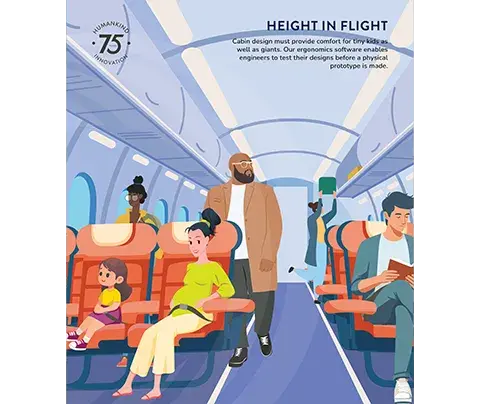
An airplane cabin must work for the small, the tall— and everyone in between. That’s the design problem that Humanetics' ergonomics software is built to solve.
Of course, no algorithm fully replaces kind gestures that get us through a flight: a taller passenger lifting a bag into the overhead bin, or a smaller one retrieving a dropped phone from under the seat. Those are pure human kindnesses.
But the cabin itself - the seat geometry, the reach, the sightlines, the safety envelope – are engineered kindness, that ensure comfort and safety for every BODY.
Good design balances safety and comfort. Great design makes humans want to show kindness of their own.
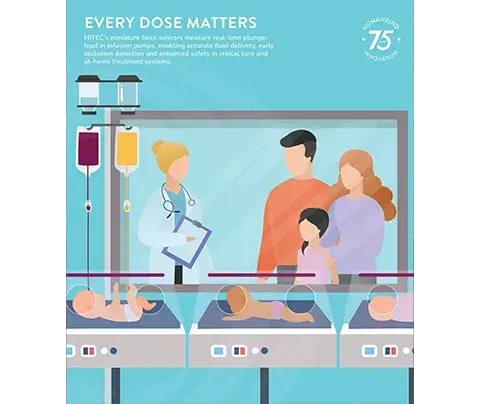
In intensive care, confidence and trust is everything.
Sensing technologies enable infusion systems to deliver precise drug delivery and system monitoring so doctors can focus on the patient’s well-being and getting home safely.
Because accuracy builds trust in every setting.
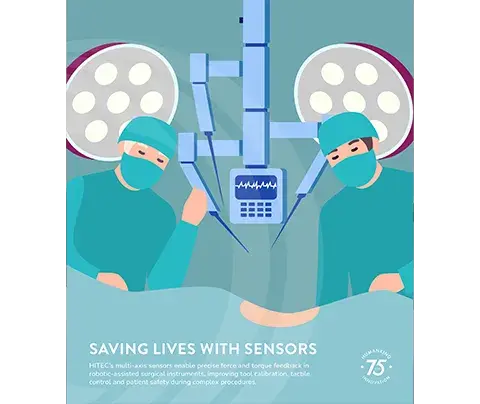
Precision isn’t optional in the operating room.
Instrumenting surgical tools provides data and real-time insight to enhance surgical procedures and patient recovery.
Surgeons have more confidence and a better bedside manner. Patients have better outcomes.
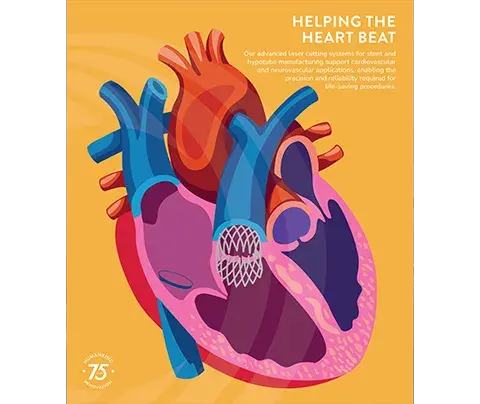
Sometimes the most important innovations are the ones we never see.
Medical technologies, like stents, rely on precision engineering to support life in critical moments, restoring flow, stability, and confidence. Our precision laser engineering is used to develop critical components in medical devices.
It’s where engineering meets care in its most direct form.
In healthcare, precision saves lives.
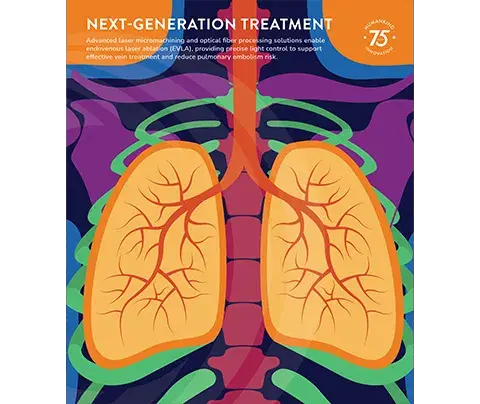
Pulmonary embolism (PE) is one of the leading causes of cardiovascular death worldwide, responsible for an estimated 100,000 deaths each year in the United States alone.
Advanced laser micromachining and optical fiber processing technologies are helping redefine how clinicians treat complex vascular conditions — enabling minimally invasive procedures designed to reduce the risk of pulmonary embolism and improve patient outcomes.
Using highly precise laser ablation techniques, OpTek Systems supports the development of next-generation medical devices that help physicians target treatment with greater accuracy, control, and confidence.
Because when treating life-threatening conditions, innovation must do more than advance technology — it must improve the human outcome behind every procedure.
Modern industry depends on precision, where failure is not an option.
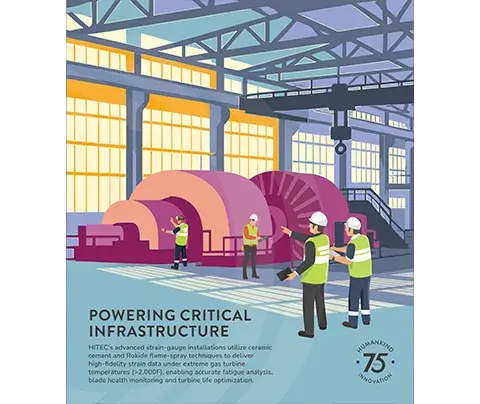
Gas turbines operate at temperatures exceeding 2000°F, and understanding how their components perform under extreme stress is critical — not only for operational performance, but for the people and communities who rely on these systems every day.
From powering hospitals and transportation networks to supporting manufacturing and essential infrastructure, turbine reliability has a direct impact on human safety, energy stability, and economic resilience.
HITEC’s advanced strain gauge technologies deliver high-fidelity strain data in some of the harshest operating environments on earth — enabling accurate fatigue analysis, real-time blade health monitoring, and turbine life optimization.
This deeper insight helps engineers detect issues earlier, reduce the risk of catastrophic failure, improve efficiency, and extend the lifespan of critical infrastructure systems that millions depend on.
Building the future requires more than strength. It requires awareness.
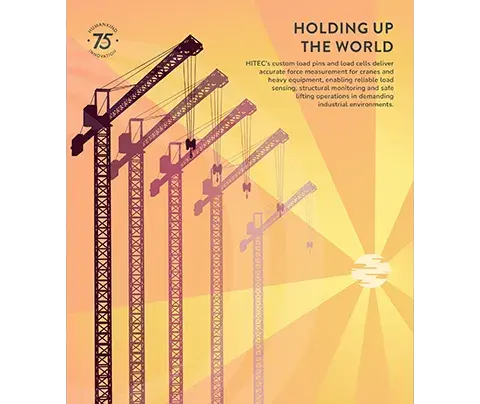
Overloading and load instability are among the most common contributing factors of crane-related accidents across construction and heavy industrial environments, with hundreds of fatalities and thousands of injuries globally each year.
That’s why real-time insight matters.
HITEC’s load pins and load cells help monitor force, stress, movement, and structural stability in some of the world’s most demanding operating conditions — giving engineers the critical data needed to detect overload risks before failure occurs.
From cranes and lifting systems to major infrastructure projects, these advanced sensing technologies help improve operational efficiency, reduce downtime, and better protect both people and equipment on site.
Because progress should never come at the cost of safety.
Modern energy systems depend on something most people never see: constant awareness.
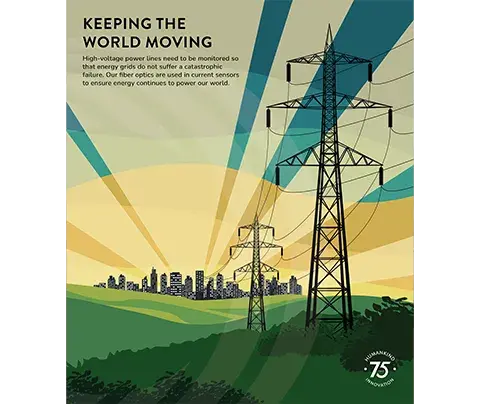
High-voltage power lines must be continuously monitored to help prevent catastrophic failures across the energy grid systems that power our world every day.
Fibercore's specialty optical fiber is used in advanced current-sensing systems that provide the real-time insight needed to detect faults faster, improve grid reliability, and support safer, more resilient energy infrastructure.
As energy demand grows and grids become more connected and complex, accurate current measurement plays a critical role in keeping power flowing across communities, transportation networks, hospitals, industries, and critical infrastructure.
Because when energy systems operate smarter, the world moves more safely and reliably.
The future of energy will depend on how intelligently we harness the forces around us.
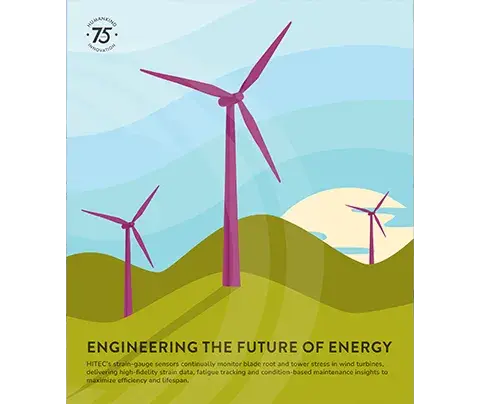
Today, wind energy generates more than 2,300 terawatt-hours of electricity globally each year — enough to power hundreds of millions of homes while helping reduce reliance on fossil fuels and lower carbon emissions worldwide.
HITEC’s strain gauge sensors continuously monitor blade root and tower stress of wind turbines, delivering high-fidelity strain data, fatigue tracking, and condition-based maintenance insights in environments where reliability is critical and conditions are constantly changing.
These real-time insights help operators maximize efficiency, extend turbine lifespan, reduce unplanned maintenance, and generate renewable energy more safely and consistently for the communities that rely on it.
Because renewable power is not just about generating energy — it is about building resilient systems that can sustain progress for generations to come.
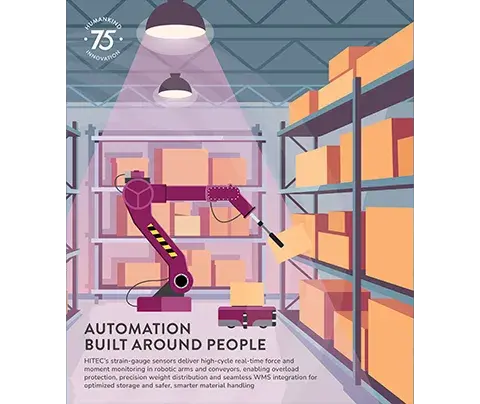
As robotics becomes more integrated into manufacturing, logistics, healthcare, and mobility, advanced sensing technologies are helping machines move with greater precision, respond in real time, and operate more safely alongside people — reducing injuries, improving reliability, and enabling smarter, more efficient operations.
HITEC’s strain gauge sensors provide real-time force and moment monitoring in robotic arms and conveyor systems, enabling overload protection, precision weight distribution, and seamless warehouse integration for safer material handling.
The impact goes beyond automation performance. It means safer factory floors, fewer equipment failures, faster movement of critical goods, and more resilient supply chains.
Because the future of automation is not about replacing people.
It is about engineering technologies that work alongside us to create safer, smarter industries built around human needs.
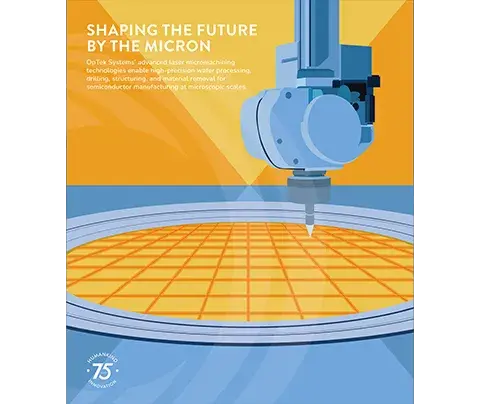
At the smallest scales, precision defines what’s possible.
A human hair is around 80–100 µm wide, while advanced semiconductor features measure just 0.002 µm (2 nm) — approximately 40,000× smaller.
That’s where OpTek Systems helps manufacturers see and measure what the human eye cannot.
OpTek Systems supports critical laser micromachining processes used in wafer dicing, drilling, structuring, and material processing — helping semiconductor manufacturers improve alignment accuracy, reduce defects, increase yield, and maintain consistency at incredibly small scales.
As chips become more complex and demand for high-performance electronics continues to accelerate, precision manufacturing is no longer optional. It is foundational to the technologies shaping modern life — from AI and autonomous systems to medical devices, mobility, and global connectivity.
Because behind every breakthrough in computing power is a manufacturing process engineered with microscopic precision.
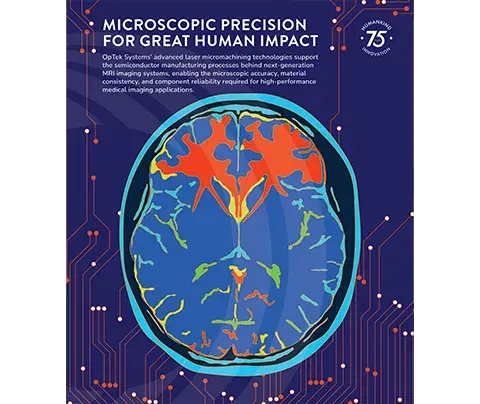
Modern MRI technology depends on precision where there is no margin for error.
Behind every high-resolution scan is a complex network of semiconductor devices processing enormous volumes of data in real time — helping clinicians detect disease earlier, diagnose with greater confidence, and make critical decisions faster for the patients depending on them.
OpTek Systems supports these critical manufacturing processes through high-precision laser micromachining technologies that help improve alignment, material processing, and production quality for the semiconductor components, enabling next-generation medical imaging.
Because when precision improves at the microscopic level, confidence improves at the human level — for clinicians, patients, and every decision that follows.
Protecting people starts with understanding people.
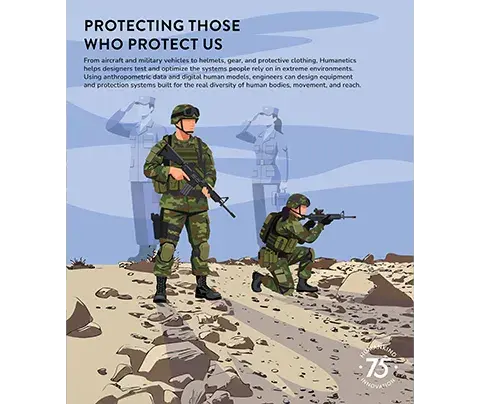
From aircraft and military vehicles to helmets, protective gear, and the equipment used in extreme environments, the systems trusted by those who protect us must perform safely for every BODY, not just the average.
That’s why Humanetics combines anthropometric data, digital human models, and safety engineering to help designers test and optimize both the vehicles people operate and the gear they depend on. By understanding the real diversity of human size, shape, movement, and reach, engineers can create systems that improve mobility, protection, comfort, and performance under pressure.
Because when design accounts for real human variability, more people can operate with confidence, stay protected, and return home safely.
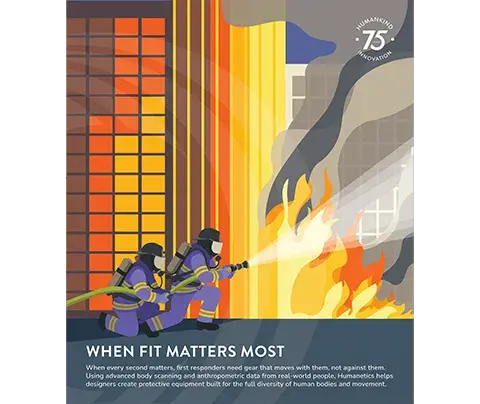
When first responders answer the call, their focus should be on saving lives, not fighting against the gear meant to protect them.
From protective clothing and helmets to emergency response equipment used in extreme conditions, every detail of fit matters. Gear that fits properly improves mobility, reduces strain, and helps first responders move quickly, safely, and confidently when seconds count.
That’s why Humanetics combines advanced body scanning, digital human models, and anthropometric data from real-world people to help designers create equipment built for every BODY.
Because protecting first responders starts with designing gear that protects every responder.
And when the people who protect us can perform at their best, entire communities are safer because of it.
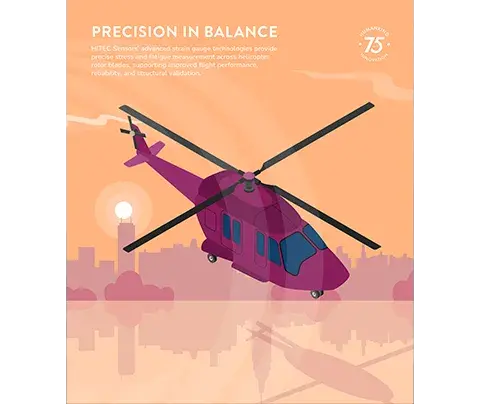
Flight depends on precision long before wheels leave the ground.
Every flight carries something invaluable: people returning home, families reuniting, medical teams responding to emergencies, and communities staying connected across the world.
From rotor blade dynamics to structural load monitoring, advanced sensing technologies help aircraft respond to constantly changing forces in real time — supporting greater stability, performance, and safety in some of the world’s most demanding operating environments.
HITEC’s precision strain gauge technologies provide the critical data engineers need to better understand stress, vibration, and fatigue across aerospace systems, helping detect issues earlier, improving reliability, and supporting safer journeys for the millions of people who rely on air travel every day.
Because in aerospace, even the smallest imbalance can have enormous consequences — and greater insight helps protect the lives behind every flight.
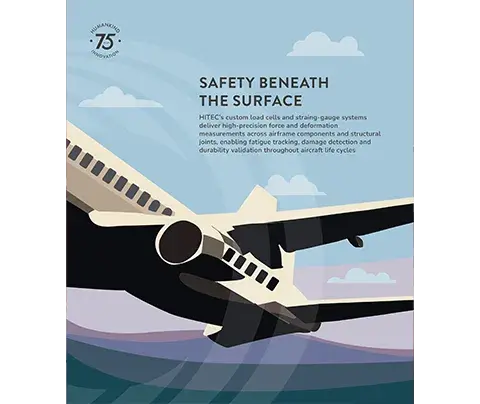
A modern commercial airliner can place over 625 tons of force through its wings and fuselage during extreme flight conditions.
That is why structural health monitoring plays such a critical role in modern aerospace engineering.
HITEC’s custom load cells and strain gauge systems deliver high-precision force and deformation measurements across airframe components and structural joints, enabling fatigue tracking, damage detection, and durability validation throughout an aircraft’s lifecycle.
These advanced sensing technologies provide ongoing insight into airframe integrity, helping engineers detect issues earlier, reduce maintenance uncertainty, and support safer, more reliable aircraft performance across thousands of flight hours.
Because safer flight is not only built through innovation in the air — but through the invisible systems working continuously behind the scenes to protect every journey.
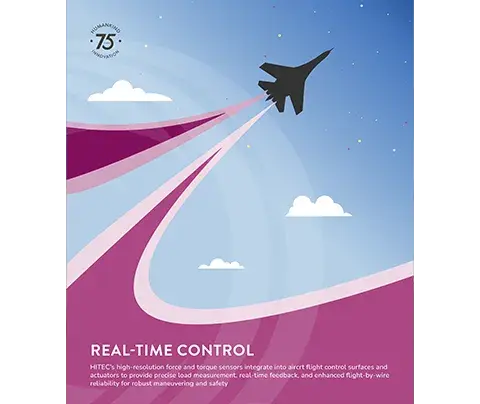
In the air, every decision happens in real time. Pilots rely on immediate, accurate feedback to maintain control, respond to changing conditions, and operate safely in some of the world’s most demanding environments.
That level of awareness depends on precision engineering working behind the scenes.
HITEC’s high-resolution force and torque sensing technologies integrate directly into aircraft flight control systems and actuators, delivering the real-time load measurement and responsiveness needed to support smoother maneuvering, enhanced flight-by-wire performance, and greater pilot control awareness.
From takeoff to landing, these insights help pilots make faster, more informed decisions with greater confidence when every movement matters most.
Because safer flight is built on more than performance alone — it is built on giving pilots the clarity and control they need to do their job at the highest level.
Behind every passenger heading home, every family crossing continents, and every crew responsible for the people onboard is an invisible network of engineering designed to keep aircraft performing safely under extraordinary conditions.
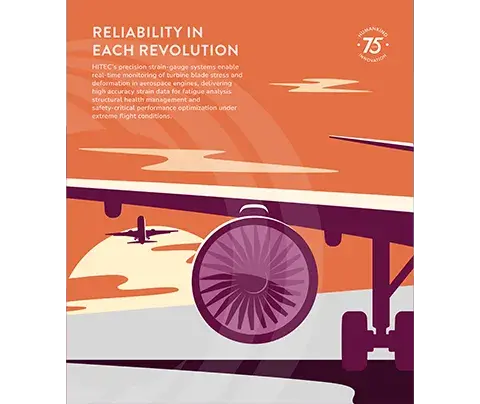
Inside modern aerospace engines, turbine blades endure extreme heat, pressure, vibration, and rotational stress at thousands of revolutions per minute — where even the smallest structural change can affect engine efficiency, operational reliability, and ultimately, human safety.
In these environments, precision sensing is not optional. It is critical.
HITEC’s advanced strain gauge systems provide the real-time insight engineers need to monitor turbine blade stress and deformation under demanding flight conditions. By delivering highly accurate strain data for fatigue analysis, structural health monitoring, and performance optimization, these technologies help identify potential failures before they become critical risks.
The impact goes far beyond engine performance.
It means safer aircraft operation, greater reliability across thousands of flight hours, reduced maintenance uncertainty, and stronger confidence for the millions of people who rely on air travel every single day.
Because in aerospace, protecting human life often depends on the ability to measure what others cannot see.
At sea, every decision impacts human lives.
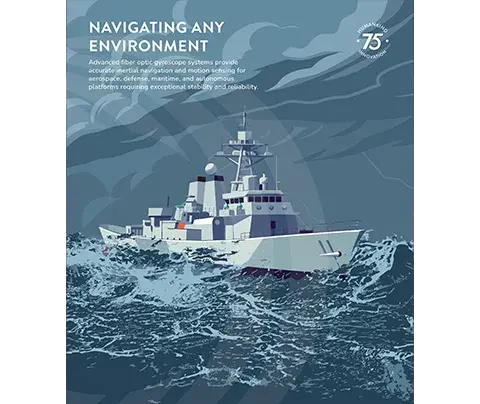
From cargo crews navigating extreme conditions to offshore teams powering critical industries, maritime operations depend on technologies that help people move, work, and return home safely.
Advanced manufacturing and precision-engineered sensing systems are transforming how vessels operate in some of the world’s harshest environments — delivering the real-time insight needed to improve navigation accuracy, vessel stability, and operational awareness when conditions become unpredictable.
Fibercore’s fiber optic gyroscope technologies help support safer maneuvering, more reliable positioning, and greater confidence across commercial shipping, offshore infrastructure, defense, and autonomous marine systems.
Behind every advancement in maritime technology is something deeply human: protecting the people, industries, and global communities that rely on safe movement across the world’s oceans every day.
Seeing the unseen helps to protect what matters most.
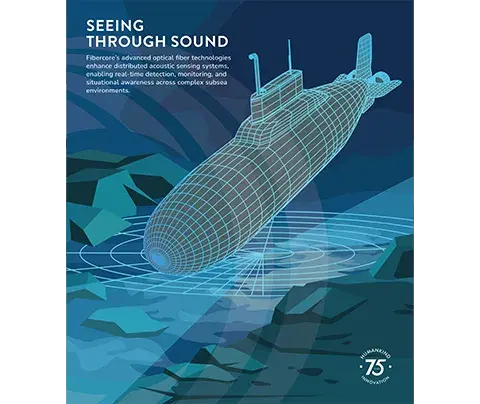
Across subsea environments, acoustic sensing technologies are helping detect, measure, and respond to signals that would otherwise go unnoticed — often across vast distances and in some of the harshest conditions on earth.
Fibercore’s advanced 50µm single-mode optical fiber technology is engineered to enhance the performance of distributed acoustic sensing systems, delivering greater sensitivity, improved signal clarity, and more reliable detection in demanding environments where precision matters most.
From monitoring offshore infrastructure and subsea activity to supporting environmental sensing, these technologies help operators gain deeper awareness in places where traditional sensing methods face limitations.
This deeper awareness helps prevent failures before they escalate, protect critical infrastructure communities rely on every day, support safer operations for workers in high-risk environments, and improve response times when every second matters.
Connection isn't limited to the Earth’s surface — it extends more than 22,000 miles into orbit.
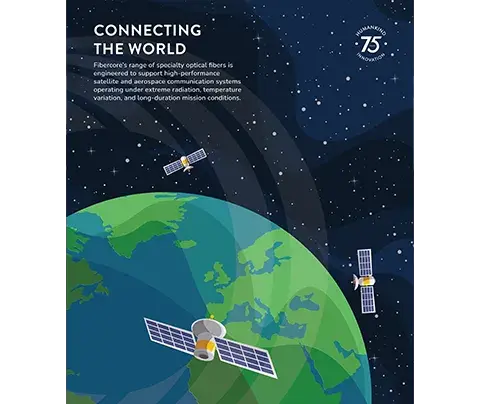
Every message sent, every call home, and every moment of global connectivity depends on satellites operating reliably in the harshest environment imaginable.
Today, more than 7,500 active satellites orbit Earth, supporting everything from GPS navigation and emergency communications to banking systems, aviation, weather forecasting, and global internet connectivity.
In space, communication systems must withstand radiation exposure, temperature swings ranging from -150°C to over 120°C, and years of continuous operation without failure — where even the smallest disruption can impact millions of people on Earth in seconds.
Fibercore’s range of specialty optical fibers helps enable high-performance satellite-to-satellite communications, supporting the fast, stable, and reliable transmission of data across orbiting networks that move vast amounts of information around the globe every day.
From global communications infrastructure and navigation systems to earth observation and defense applications, these advanced optical fiber technologies are engineered to perform where reliability is mission critical — helping support systems the modern world depends on 24 hours a day, 365 days a year.
Because beyond every signal in space is something deeply human: the ability to stay connected to the people who matter most.
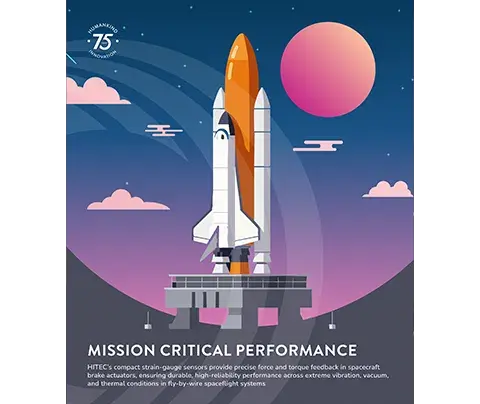
Space is unforgiving — where precision can mean the difference between mission success and catastrophic failure.
Beyond Earth’s atmosphere, spacecraft operate under extreme vibration, acceleration, vacuum conditions, and dramatic temperature fluctuations — environments where reliability is essential not only for technology, but for the people who depend on it.
HITEC’s compact strain gauge technologies provide the precise force and torque feedback engineers rely on to monitor structural behavior, validate system performance, and support safer, more reliable operation across aerospace and spaceflight systems.
From spacecraft brake actuators in fly-by-wire systems to launch platforms and satellite structures, these high-reliability sensors are engineered to perform under the harshest conditions imaginable — helping protect missions, preserve critical communications, support scientific discovery, and advance the technologies that keep our world connected.
Because every breakthrough in space exploration ultimately serves life here on Earth — improving navigation, communication, security, research, and our understanding of the world around us.
And when operating beyond Earth, every measurement matters.
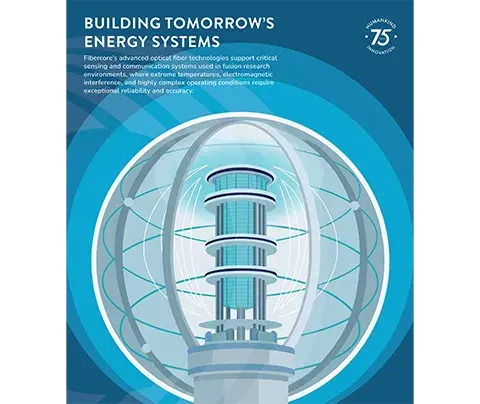
The pursuit of fusion energy has the potential to redefine how the world is powered — offering a cleaner, more sustainable energy future built on one of the most complex scientific challenges ever undertaken.
A future with fusion energy could mean lower emissions, more resilient energy systems, and access to reliable power for generations to come — helping support healthier communities, stronger infrastructure, and a more sustainable planet.
But advancing fusion research demands more than ambition. It demands technologies capable of performing with extraordinary precision in some of the harshest environments imaginable.
Fibercore’s advanced optical fiber technologies support critical sensing and communication systems used in fusion research environments, where extreme temperatures, electromagnetic interference, and highly complex operating conditions require exceptional reliability and accuracy.
These high-performance fibers help enable the precise monitoring and data transmission researchers depend on to better understand, control, and advance next-generation fusion systems.
Because breakthroughs at this scale are not only about advancing science.
They are about creating technologies that could fundamentally improve how people live, power communities more sustainably, and help build a safer future for the world around us.
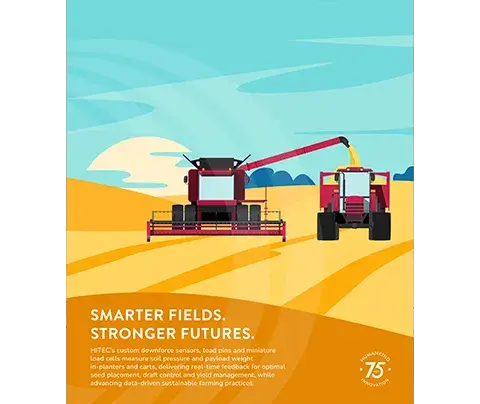
Feeding the future takes more than scale. It takes precision.
Modern agriculture faces growing pressure to produce more food with fewer resources while adapting to increasingly unpredictable conditions. By 2050, global food demand is expected to increase by nearly 60%, while farmers must do more with limited land, water, fuel, and labor resources.
Advanced sensing technologies from HITEC are helping farmers meet that challenge — providing real-time insight into force, load, pressure, torque, and equipment performance across tractors, harvesters, and other critical machinery operating in demanding environments.
These technologies help improve efficiency, reduce downtime, optimize fuel and fertilizer use, and support safer, more sustainable farming operations. Precision agriculture technologies alone have been shown to reduce fertilizer use by up to 30% while improving crop productivity and operational efficiency.
Innovation in agriculture reaches far beyond the field — helping nourish growing populations, strengthen local economies, and support a more sustainable future for generations to come.
In some of the harshest environments on earth, precision becomes critical long before danger is visible.
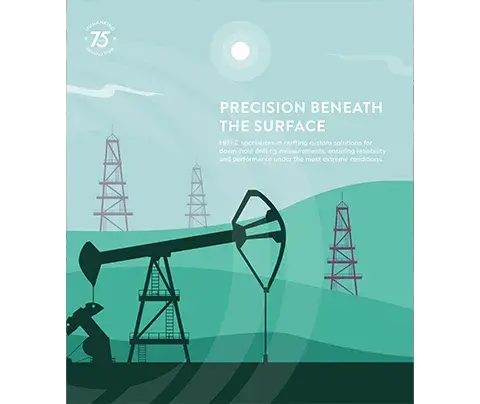
Deep beneath the surface, down-hole drilling operations expose workers and equipment to extreme pressure, heat, vibration, and mechanical stress — where reliable measurement is essential to maintaining safety, operational control, and confidence in every decision being made underground.
The conditions are unforgiving. Down-hole tools can operate at pressures exceeding 20,000 psi and temperatures above 200°C (392°F), leaving little margin for error when people, infrastructure, and environmental safety are at stake.
In these environments, early insight matters. A single undetected issue can place crews at risk, disrupt critical operations, and impact the systems communities rely on every day.
HITEC specializes in custom sensing solutions for down-hole drilling applications, delivering the precise force and strain measurements engineers need to better understand system behavior, identify potential issues earlier, and maintain reliability under some of the most demanding operating conditions imaginable.
These advanced technologies help support safer operations, improve decision-making in real time, reduce unnecessary risk, and strengthen the reliability of critical energy infrastructure around the world.
Because in extreme conditions, better insight does more than improve performance.
It helps protect the people working in these environments — and the communities that depend on them.
Let's build what's Next
Behind every innovation is a human outcome. Complete the form to learn how Humanetics technologies can support your team’s next project across mobility, healthcare, aerospace, and energy.
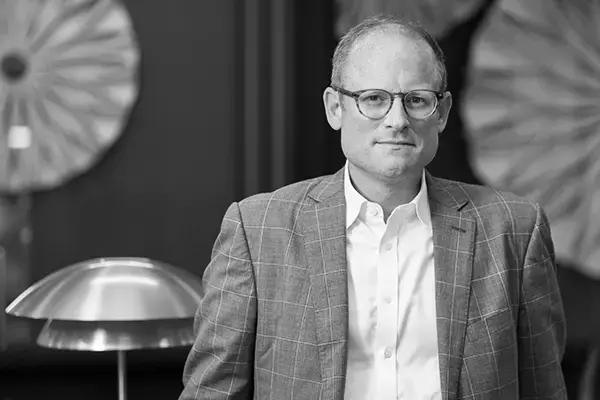
Barney Loehnis
Barney is the President of Humanetics Sensors & Chief Marketing Officer, leading our Sensor group and marketing growth programs, strategic communications, and customer experience design. He has led marketing and digital transformations in Europe, Asia and the USA in B2B, B2C and agency sectors, for clients like IBM, VW, Huawei, Qualcomm and Mercer Consulting. Barney is a British and American citizen, a bad runner and avid cook.