
How do you design for a moving target?
Product developers across industries face a fundamental challenge: human body characteristics change over time.
Population demographics and anthropometry are shifting because of aging societies, regional diversity, and lifestyle changes. Body proportions, posture, and distribution of sizes evolve. Yet many design processes still rely on outdated anthropometric (body data) or limited sample sizes.
This creates a growing mismatch between product design assumptions and real-world users.
Whether in apparel, mobility systems, or industrial equipment, poor fit directly affects usability, safety, and customer acceptance.
In this article, we’ll look at how body data from modern 3D scanners can help you make better and safer designs.
The Limitation: Outdated Data and Manual Measurement
Two key limitations constrain traditional body data measurement.
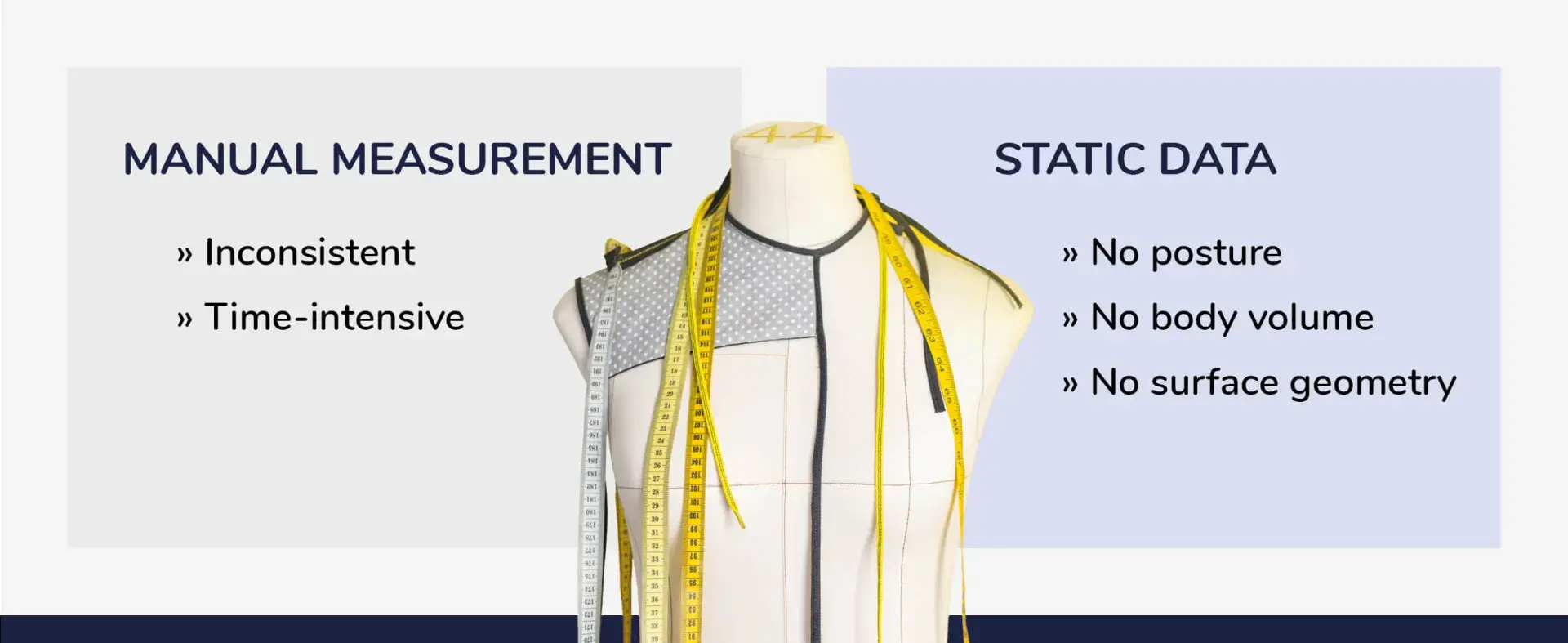
First, manual measurement processes are inherently inconsistent and time intensive. Manual measurements “never get the same results twice”. They usually depend on the operator.
Second, manual measurement fails to capture the full complexity, shape, and volume of the human body. This data is better represented by 3D body scanning technology.
The Solution: From Manual Measurements to Digital Body Data
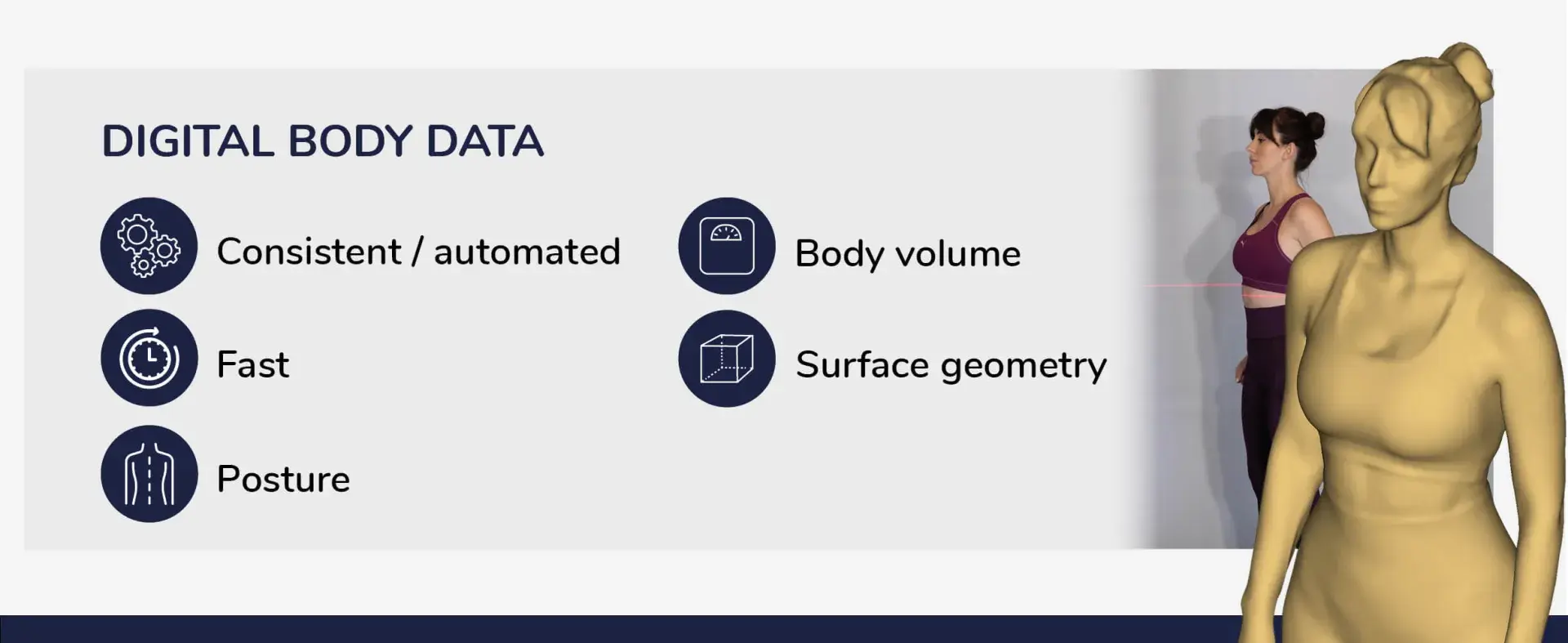
3D body scanning greatly improves your ability to capture and use human shape data. Here's what to look for in a modern system:
- Full-body surface area scanning within seconds
- High resolution: measured in points per cm² (for example: VITUS Bodyscan captures approx. 300 points per cm²)
- Stores ISO-compliant results (ISO 20685, ISO 8559, ISO 7250)
- Automated body data processing and extraction
Body scanning hardware and software with these features let you set up scalable data collections. You can use this across regions and populations.
More importantly, modern 3D scanning captures full body shape, posture, and volume. This provides a much richer representation of all kinds of human shapes.
Ways to Use Body Data to Your Advantage
Here are some proven ways to use body data to improve your products and workflows.
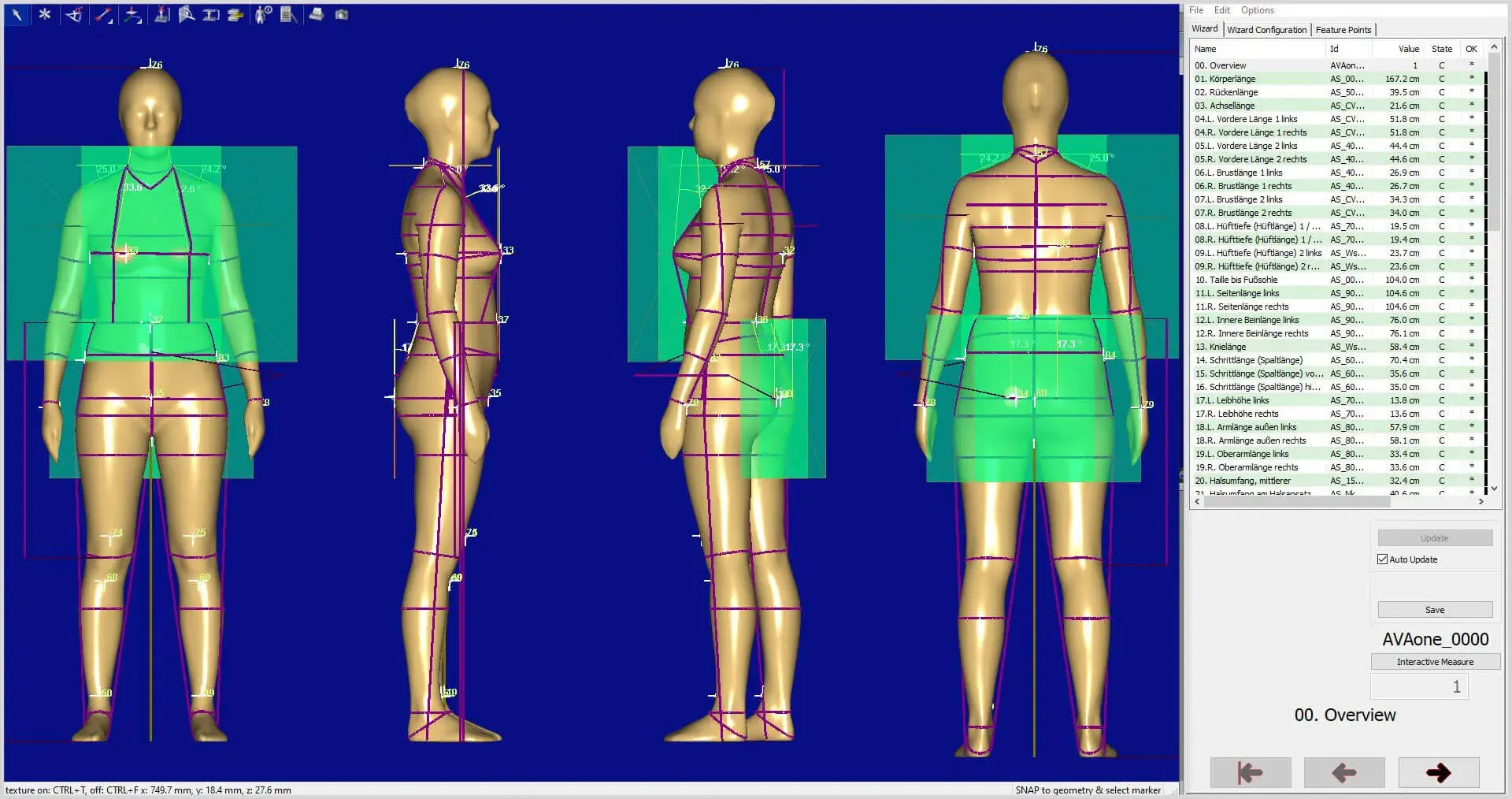
1: Standardized Data Processing
Raw scan data alone is not sufficient. The key lies in transforming it into standardized, comparable information.
Anthroscan provides standardized data processing, enabling consistent extraction of body data measurements from 3D scans.
The software supports:
- Automated extraction of more than 150 body measurements
- Landmark detection and measurement consistency
- Volume, surface, and skeletal calculations
- Measurement protocols based on, ISO 8559, and ISO 7250
- Unlimited custom measurement types with interactive tape measure
In addition, you can customize measurement definitions and batch processing. This helps you handle large datasets and repeated measurements.
This ensures that scan data becomes reliable, comparable, and ready for further use.
Standardized processing keeps body data comparable across populations and over time.
2: Develop a Connected Data "Ecosystem"
Data works best when everything connects. Only Humanetics provides an integrated approach to body data solutions: connecting data acquisition, processing, management, and downstream usage.
We have a complete solution integrating scanner operations and data processing.
INTEGRATED HARDWARE
First, choose hardware that meets your needs:
- VITUS Bodyscan for high-precision, research-grade data capture
- ANTHROSCAN Mobile 3D for portable, flexible, and scalable scanning scenarios
INTEGRATED SOFTWARE
Then, Anthroscan software provides standardized measurement extraction and analytical tools. Capture more than 150 body measurements automatically and interactively with arbitrary length, girths, and angles.
Use Anthroscan Connect for web-based data management, visualization, and analysis. Anthroscan Connect enables efficient handling of your scan data, sociodemographic information, and body measurements
You can combine Anthroscan with iSIZE, the powerful solution for population-based design strategies. iSIZE lets you transform raw body data into actionable insights for data-driven product optimization.
This creates a continuous workflow:
Interested in More Content Like This?
Subscribe to the Humanetics Pulse newsletter to learn more about Humanetics Products, News, and Industry Updates.
- Scan: acquire high-quality data with a 3D body scanner
- Measure: extract unlimited standard and custom body measurements automatically with Anthroscan’s powerful measurement engine
- Analyze: gain deeper insights through advanced data analysis with Anthroscan and Anthroscan Connect
- Manage: organize and securely store data with the Anthroscan Connect web-based portal
- Apply: Use insights to improve your products for a specific population with iSIZE
You can also export the data in standard 3D formats (OBJ, STL). Engineering and simulation environments will support your compatible data.
3: Design for Real Populations
Capturing real population diversity has direct and measurable impact on product development.
- Improved Product Fit - Accurate and up-to-date body data enables better sizing strategies and reduces mismatch
- Data-Driven Ergonomics - Designers can base decisions on real human geometry rather than assumptions
- Scalable Population Analysis - Large datasets enable segmentation, clustering, and global comparisons
- Continuous Adaptation - Organizations can monitor how populations evolve and update products accordingly
Key Takeaway: Manual Body Measurement Data Alone Won’t Cut It
Population diversity is increasing, making body measurement data insufficient. Developing a 3D body data collection process workflow gets you fast, repeatable, and ISO-compliant data.
Integrated data processing with Anthroscan, the management of the body scanning data with Anthroscan Connect and population modeling with iSIZE help you improve product performance.
Keep Learning
We have more information about working with 3D body scanning data. We also have experts ready to help with your projects.
Talk to an Expert
Contact our body data experts to learn how we can help with your design projects.
Frequently Asked Questions
What Is Anthropometric Data?
Anthropometric data refers to the systematic measurement of human body dimensions and the human body's physical characteristics. Designers of all sorts use this data to improve products for potential customers:
- Clothing, fashion and, couture
- Personal protective equipment (PPE)
- Ergonomics design
- Vehicle safety (crash testing)
- ...and more
What Is 3D Body Scanning?
3D body scanning is a technology that captures the precise shape and body dimensions of a human body. Many product designers in many industries use it for digital human modeling:
- Fashion and apparel (fit forms)
- Automotive and vehicle designers (ergonomics data and crash safety design and simulation)
- Retail
- Healthcare
What is the ISO 20685 protocol?
International Standards Organization (ISO) 20685 is a standard that outlines procedures for the application of 3D surface scanning systems for obtaining data related to the human body, and for measurements specified in DIN EN ISO 7250-1. It is applicable to both whole body scanners and body part scanners (such as head, hand, and foot scanners). This standard is particularly useful for those creating anthropometric databases and for users of data obtained through 3D scanners.
What is the ISO 8559 protocol?
(ISO) 8559 is a set of body measurement definitions. The document provides guidance on how to perform anthropometric measurements. It offers clothing product development teams and fit mannequin manufacturers with information on measurement principles, including their anatomical and anthropometric foundations.
What is the ISO 7250 protocol?
ISO 7250 is an international standard that defines essential anthropometric measurements of the human body for technological design, providing guidelines for ergonomists and designers.
It serves as a guideline for conducting anthropometric measurements. It also provides ergonomists and designers information on the anatomical and anthropometric principles underlying measurement methods used in design applications.
Dr. Martin Groeber
Dr. Martin Gröber is Manager of Product Management for Body Scanning at Humanetics, where he drives the development of human-centered solutions at the intersection of ergonomics, body data, and product innovation. With a background in biomechanics and a PhD from the University of Vienna, his work spans from body scanning solutions to advanced human modeling in automotive design.
Before stepping into product management, Martin gained experience as an application engineer and later led the ergonomics consulting team, helping translate complex human data into practical design decisions. Alongside his industry role, he continues to share his expertise as a lecturer at the Technical University of Munich, teaching the next generation of engineers the fundamentals of human modeling with RAMSIS.
Whether developing advanced body scanning technologies or optimizing vehicle interiors, Martin’s focus remains the same: making products better by putting humans at the center.