


Q-Series Q10 Dummy
- Standard Q10 ATD 010-0000
In the early 1990s, statistics showed that there was much room for improvement in the design of child restraint systems (CRS) in vehicles. The existing P-Series of child dummies used for testing CRS had a simple design and were limited in their measurement capability.
Our Q-Series of child dummies were developed in 1993 as successors to the P-Series in the hopes of giving engineers the information they needed to design greater impact protection for children in cars. This new generation of dummies has much better anthropometry, biomechanics, and kinematics, all key to better evaluating the risk of injury to varying ages and sizes of child passengers. The Q-Series can be used in frontal or side impact testing, and the instrumentation is interchangeable within the dummy series.
The Q10 dummy was updated in 2015 to improve shoulder belt stability and overall performance in restraint system evaluations. The revised hardware configuration incorporates design enhancements to the shoulder region and is available as both a complete dummy and as a modification kit for upgrading existing Q10 production dummies to the latest configuration.
Specifications
Key Features
- Rigid plastic skull with accelerometer cavity, soft durable head skin with biofidelic response.
- Neck consists of rubber segments between metal plates to allow realistic flexion, extension and lateral flexion rotational behavior.
- Shoulder incorporates a ball and socket joint to simulate the humerus-scapula joint with a scapula distributing load at the back.
- Frictional adjustment included for positioning the arms.
- Abdomen: APTS pressure sensors to measure belt pressure, particularly for submarining
- Sit-stand designs, anatomically shaped bony parts from anatomical data and child X-rays.
- Q10 pelvis is a more detailed design having a construction like WorldSID for enhanced side impact biofidelity and additional sensors.
Product Specifications
| Sitting Height | 733.7 mm | 28.9 in |
| Stature | 1,453.2 mm | 57.2 in |
| Shoulder Height (top of arm) | 472.6 mm | 18.6 in |
| Shoulder Pivot Height | 443.8 mm | 17.5 in |
| Hip Pivot Height | 65.9 mm | 2.6 in |
| Hip Joint Distance | 132 mm | 5.2 in |
| Thigh Height | 114 mm | 4.5 in |
| Lower Arm & Hand Length | 376.2 mm | 14.8 in |
| Shoulder to Elbow Length | 291.6 mm | 11.5 in |
| Buttock Popliteal Length | 414.9 mm | 16.3 in |
| Popliteal Height | 405.7 mm | 16 in |
| Buttock to Knee Length | 485.4 mm | 19.1 in |
| Chest Depth | 171 mm | 6.7 in |
| Foot Breadth | 86 mm | 3.4 in |
| Head Circumference | 534 mm | 21 in |
| Chest Circumference | 623.6 mm | 24.6 in |
| Waist Circumference | 664.6 mm | 26.2 in |
| Total Weight | 35.58 kg | 78.4 lb |
Applications
- Vehicular front and side impact testing.
Regulations
| WHERE USED | DEFINING REGULATION |
|---|---|
| ANCAP | UNECE Regulation 129, Euro NCAP Frontal MPDB, Side MDB protocols |
| ASEAN NCAP | UNECE Regulation 129, Euro NCAP Frontal MPDB, Side MDB protocols |
| C-NCAP | UNECE Regulation 129, Euro NCAP Frontal MPDB, Side MDB protocols |
| Euro NCAP | UNECE Regulation 129, Euro NCAP Frontal MPDB, Side MDB protocols |
| KNCAP | UNECE Regulation 129, Euro NCAP Frontal MPDB, Side MDB protocols |
| Latin NCAP | UNECE Regulation 129, Euro NCAP Frontal MPDB, Side MDB protocols |
| UN R129 | UNECE Regulation 129, Euro NCAP Frontal MPDB, Side MDB protocols |
Instrumentation
| Linear Accels | Angular Velocity | Load Cells | Displacement | Tilt Sensor | Pressure |
|---|---|---|---|---|---|
| Head Axyz | Head ωxyz | Neck Upper Fxyz, Mxyz | Ribcage Upper Dx, Dy | Thorax | APTS 2 (abdomen) |
| Thorax Axyz | Lower Lumbar ωxy | Neck Lower Fxyz, Mxyz | Ribcage Lower Dx, Dy | Pelvis | |
| Pelvis Axyz | Lower Lumbar Fxyz, Mxyz | ||||
| Rib Cage Axy | Pelvis Fy Pubic Force | ||||
| Lower Lumbar Axy | Sacro-iliac Left & Right Fx, My | ||||
| Legs-Femur Neck Left & Right Fxyz, Mxyz |
Resources
Q10 2020 Upgrade Kit

Q10 2020 Upgrade Kit
- Standard 2020 Kit 010-4450
- Standard 2020 ATD 012-0000
After Euro NCAP began using the Q10 in their protocol in January 2016, they soon identified a need to improve the shoulder belt stability. This led Humanetics to continue the refinement of the Q10 which led to an upgraded design. The Euro NCAP Child WG then issued the set of new Q10 design requirements, and announced on September 20th, 2018 that these final updates will be applied in the Euro NCAP 2020 test protocols.
The Humanetics upgrade kit contains 13 components which conform to and pass the Euro NCAP protocol specifications. Humanetics is formally approved as a Euro NCAP certified supplier of the Q10 2020 Upgrade Kit as listed in Technical Bulletin TB 029 Euro NCAP Supplier List Version 2.0 May 2020.
KEY FEATURES
- Changed head and neck position at the neck base (forward shift 20 mm and nose up rotation 5.3 degrees)
- Shoulder-liner made out of solid polymer to shield the shoulder joints
- Eliminated scapulae
- Shifted mass from pelvis to thorax of 1.4 kg
- Solid upper legs
- Lower legs with 30 mm shortened feet
Q10 2026 Upgrade Kit
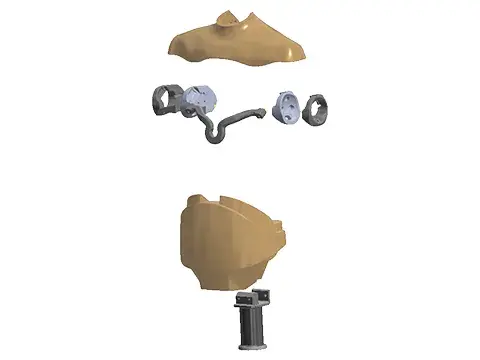
Q10 2026 Upgrade Kit
- Standard 2026 Upgrade Kit 015-2026-KIT-PR
- Standard 2026 Q10 ATD 015-0000
After Euro NCAP began using the Q10 in their protocol in January 2016, they soon identified a need to improve the shoulder belt stability. This led Humanetics to continue the refinement of the Q10 which led to an upgraded design. The Euro NCAP Child WG then issued the set of new Q10 design requirements, and announced on September 20th, 2018 that these final updates will be applied in the Euro NCAP 2020 test protocols.
The Humanetics upgrade kit contains 13 components which conform to and pass the Euro NCAP protocol specifications. Humanetics is formally approved as a Euro NCAP certified supplier of the Q10 2020 Upgrade Kit as listed in Technical Bulletin TB 029 Euro NCAP Supplier List Version 2.0 May 2020.
KEY FEATURES
- Clavicle with harmonized material specifications, checked through batch certification
- Shoulder cover and scapulas
- Lumbar spine, for which a torsion test is added
- Abdomen, for which a dynamic compression certification test is being investigated