
Street sweepers, airport sweepers, and snow plows are types of autonomous vehicles increasingly working near people every day. Have they tested their safety systems enough? Is your autonomous vehicle putting someone at risk? In this article, we explain proven active safety testing methods from the automotive industry. You'll see how autonomous cleaning or maintenance vehicles can use these proven methods.
The Problem: Gaps in Testing Create Safety Risks
Autonomous cleaning and maintenance vehicles are everywhere now. Municipalities deploy robotic sweepers to cut costs. Airports use them for FOD removal. Snow plow fleets are adding automation to clear public roads faster with fewer staff.
All these vehicles share one critical trait. They operate around workers, pedestrians, and ground crew — often at close range, often without warning.
Yet engineers still validate the safety of most of these vehicles manually. Tests are inconsistent. Data is hard to reproduce. No dedicated protocol equivalent to Euro NCAP exists for municipal or airport autonomous vehicles.
That gap is a liability — for manufacturers, for operators, and for the people who work alongside these machines.
The Solution: Applying Automotive-Grade Safety Testing
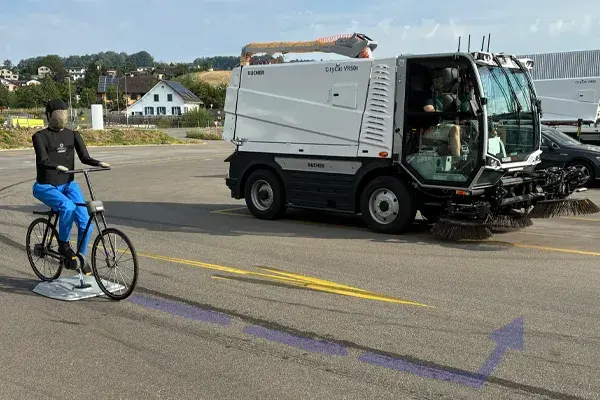
In the automotive industry, active safety testing follows a clear methodology. Someone places a target in the path of a moving vehicle. The vehicle must detect it and respond safely, repeatedly, and with measurable results.
That methodology does not change because the vehicle is a sweeper instead of a car. Both vehicles present situations where human lives or health are at risk.
What changes is the scenario library. It includes approach angles, speeds, and conditions. These reflect how real incidents happen for each vehicle type. We think the same testing methods that protect pedestrians from passenger cars can also apply to autonomous street sweepers. They can also apply to airport runway sweepers or snow plows. The Humanetics UFOnano® and UFOmicro® platforms make that possible today.
What Is a UFO Platform?
UFO stands for ultra-flat overrunable robot. The UFOmicro® and UFOnano® are the smallest platform robots available for VRU testing.
UFOnano
The UFOnano's® footprint is barely wider than a real pedestrian's shoulders. It carries adult and child pedestrian or bicyclist targets. These targets have radar, lidar, and camera signatures that match a real person.
Key capabilities:
- Zero-radius cornering: the UFOnano® turns on the spot, enabling realistic pedestrian emergence from hidden positions
- Swarm testing: Multiple units run simultaneously to simulate crowds, worker groups, or mixed pedestrian-cyclist traffic
- Hot-swappable batteries: full-day test sessions without downtime
- Euro NCAP approved for EPTa, EPTc, and EBT targets.
UFOmicro
The UFOmicro® handles higher-speed scenarios. It reaches up to 90 km/h with four-wheel drive stability. Use it for cyclists, motorcycles, and fast-moving service vehicles approaching from outside the primary detection zone.
Key capabilities:
- Up to 90 km/h with precise lateral and longitudinal accuracy.
- Multi-robot synchronization across all platforms simultaneously.
- Full ecosystem integration — pedestrian targets, bicyclist targets, and DrivingRobot actuators in one synchronized environment.
- Four-wheel drive stability on variable-grip surfaces including wet and dirty ground.
You can safely run over these platforms. If a test vehicle fails to stop, it drives over the platform. No damage, injury, or lost test day. No matter how heavy the vehicle running over the platform is.
<div id="section3"></div>
Applying These Methods to Street Sweepers in an Urban Environment
The Operating Context: Street sweepers operate in city centers, residential streets, construction zones, and market areas. They often run at night or early in the morning. Visibility is low then. Pedestrian behavior is hard to predict.
These are some of the most challenging environments for any autonomous vehicle. We see this as a setting where automotive testing can directly use active safety validation methods. Not testing here can have consequences that are just as serious.
Relevant Standards: These standards govern pedestrian detection, braking performance, speed management, and VRU collision avoidance. They are not all required for every sweeper today. These standards indicate the direction of future regulation.
- ISO 22737:2021 — Low-Speed Automated Driving (LSAD) Systems is the most directly applicable standard for autonomous street sweepers. It covers automated vehicles operating at up to 32 km/h — the typical operational speed of a street sweeper — and includes specific test procedures for pedestrian detection, cyclist detection, emergency braking, and dynamic obstacle avoidance. Crucially, it references ISO 19206-2 for pedestrian target requirements, which aligns directly with the target surrogates used on UFO platforms.
- ISO 21448:2022 — Safety of the Intended Functionality (SOTIF) addresses hazards that arise not from system failures, but from sensor performance limitations. For a sweeper's pedestrian detection system, SOTIF requires evidence of correct detection across all foreseeable scenarios (occlusion, low light, unusual pedestrian behavior) not just under ideal conditions. Physical test scenarios with the UFOnano® are a direct way to generate that evidence.
Critical Test Scenarios Include
These are the scenarios we believe matter most for street sweepers. They come from the same scenario library used in automotive VRU testing. We adapted them for the street sweeper operating environment.
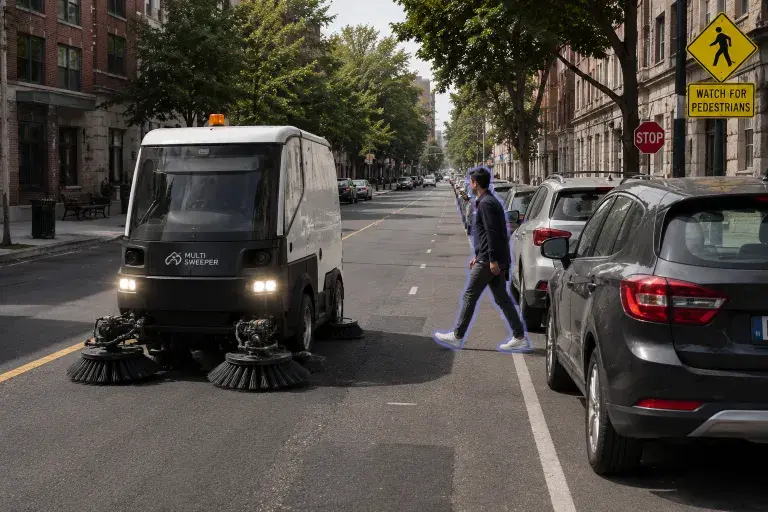
Pedestrian emergence from occlusion. A person steps out from between parked vehicles. The UFOnano® starts stationary and hidden, then moves into the sweeper's detection zone at a precise angle. ISO 22737 defines this scenario as a required test case. It also maps to ISO 21448 for validating unexpected situations.
A person steps out from between parked vehicles. The UFOnano® starts stationary and hidden, then moves into the sweeper's detection zone at a precise angle. This scenario is directly defined in ISO 22737 as a mandatory test case and maps to the ISO 21448 requirement for unexpected-situation validation.
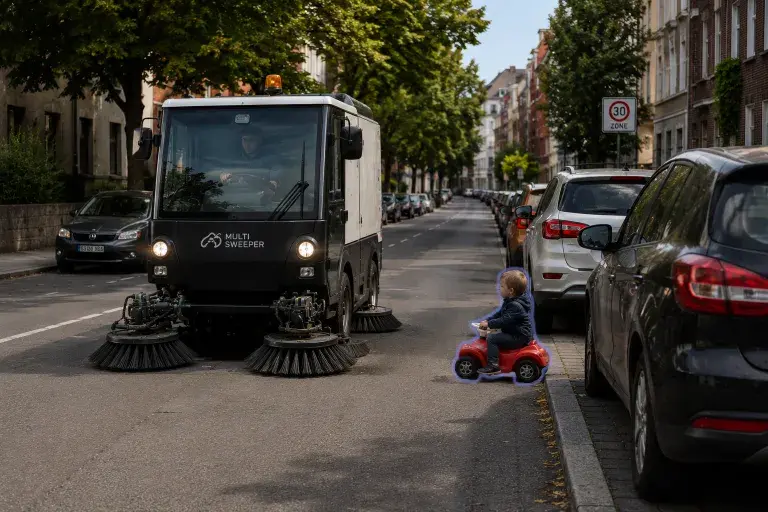
Child detection at low sensor height. Sweeper sensors are often mounted differently than those on passenger cars. A child crouching or running is easy to miss. The UFOnano® carries an EPTc or Playing Child Target (PCT) at realistic speeds — mirroring the pedestrian target test procedures specified in ISO 22737.
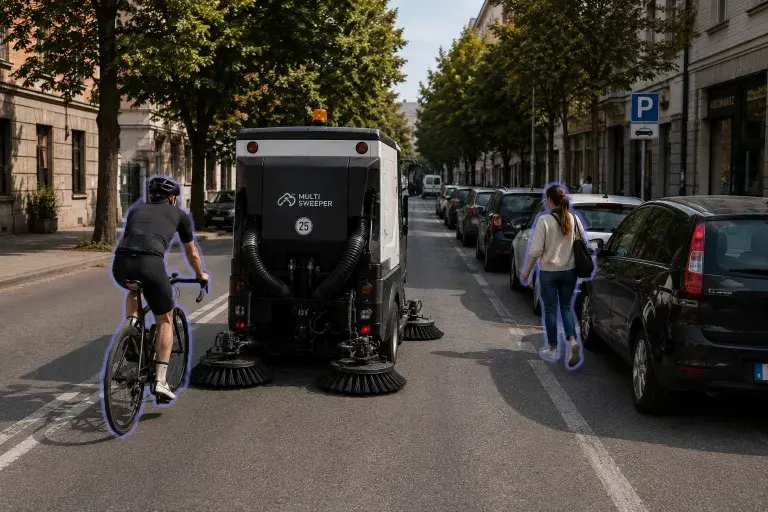
Lateral and rear-approach scenarios. Sweepers move at oblique angles and sweep in overlapping passes. Threats from the side or rear often fall outside early-generation detection zones. Multi-platform swarm configurations can stress-test 360-degree detection coverage — the same approach used in automotive ADAS validation programs.
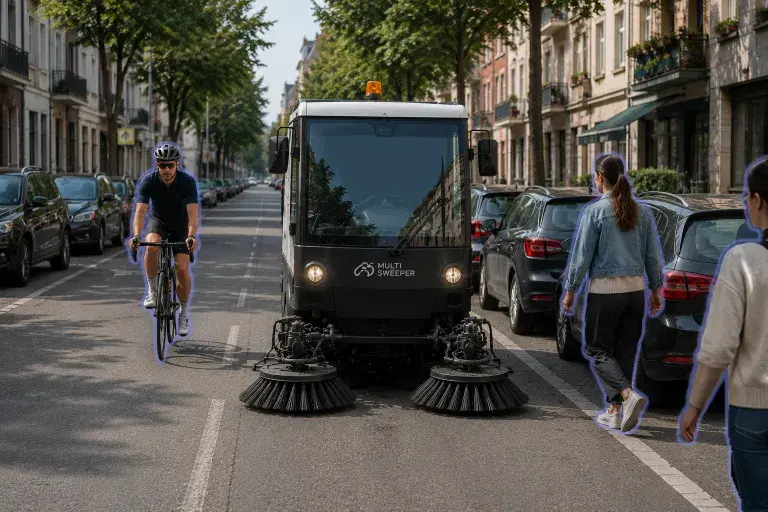
Multi-pedestrian group scenarios. Urban street environments often involve groups of people — construction workers, vendors, commuters — rather than isolated individuals. Swarm testing with multiple units carrying individual pedestrian targets, moving at varied speeds and headings, replicates the sensor-processing load of a real crowd scenario in a way that single-target testing simply cannot. This is directly relevant to SOTIF validation, which requires evidence that sensor fusion performance does not degrade under multi-target loads.
Why This Matters Now
Regulation for autonomous vehicle safety in the public-space is developing quickly. The same is true for maintenance vehicle safety.
- ISO 22737:2021 already defines specific pedestrian and cyclist detection test procedures for low-speed autonomous vehicles. Sweeper manufacturers can use it today as a validation framework, even ahead of mandatory enforcement.
- ISO 21448:2022 sets a global expectation. You must document sensor performance in all foreseeable conditions, not only ideal ones.
Manufacturers who build their validation programs now are ahead. Those who wait will be reacting to a deadline instead of owning a safety case.
The cost of not validating is real. An incident involving an autonomous sweeper and a worker is not a minor event. It hurts people, carries legal consequences, and damages reputations.
Ready to Explore What This Means for Your Vehicle?
We are experts in active safety testing for the automotive industry. We believe that expertise translates directly to autonomous cleaning and maintenance vehicles. Humanetics gives you every option to move forward:
- Purchase or rent UFOnano® and UFOmicro® platforms for in-house testing programs.
- Engage our engineers to help design and document your test campaign as a managed service.
Humanetics has decades of safety and ADAS validation expertise. We have a portfolio that is NCAP-certified, ISO compliant, and proven. The result is not just a passed test. We provide a safety case that holds up in any market.
Speak to our experts
Fill out the below form and one of our experts will contact you

Markus Schmidl
Markus Schmidl joined the Humanetics team in 2012 with the goal of taking a thorough look at the product offerings and answering the question – how can we make these products even better than they already are? With his background in printing press machine sales at Heidelberger, Markus already knew that in a machine-driven workflow, maximum efficiency is critical to success.