
Across proving grounds worldwide, the pace of ADAS and automated driving development has accelerated.
Programs are broader, protocols are more demanding, and the systems that make complex scenarios possible, such as UFO target carriers, modular DrivingRobots™, and the TrackBase Suite, are increasingly sophisticated. Yet while technology advances, training often lags.
Across the industry, engineers are asked to master complex systems with limited formal guidance. Knowledge is passed on unevenly, and written materials rarely capture the full detail of live testing. In this environment, even small misconfigurations can disrupt a carefully planned schedule, leading to costly reruns and lost track time. As protocols expand and proving grounds grow busier, the absence of structured, consistent training stands out as a barrier to both efficiency and accuracy.
Why Training Matters More Than Ever
Modern ADAS testing is precision work. Each scenario must unfold with repeatable timing and reliable conditions. A target crossing half a second too early or a vehicle braking a meter too late can invalidate hours of preparation. These margins are not trivial; they determine whether a test campaign produces valid data or has to be repeated. The challenge grows as protocols expand. Euro NCAP’s 2026 update nearly doubles the number of test scenarios compared with 2023. Scenarios once limited to a handful of variations now include dozens, with higher speeds, night-time conditions, and new vulnerable road user interactions. Swarm testing introduces multiple moving actors at once. In each case, the pressure on engineers increases because even small mistakes during setup or execution can compromise entire campaigns.
Errors in configuration, timing, or equipment handling have real consequences. A mistimed run not only wastes proving ground hours, such as one of the most limited and expensive resources, but it can also delay entire development schedules. In an industry where launch windows are tightly planned, there is little tolerance for repetition. Training is therefore not optional; it is a form of risk management, ensuring that people know how to apply systems consistently and accurately.
Our Answer: The Active Safety Academy
We created the Active Safety Academy to ensure that our systems are not just powerful in theory but effective in practice. The Academy is a web-based learning environment built specifically around Humanetics platforms. Engineers can learn at the track, in the office, or from home. They do not need to wait for a formal course or travel to a central location. Knowledge is available whenever it is needed.
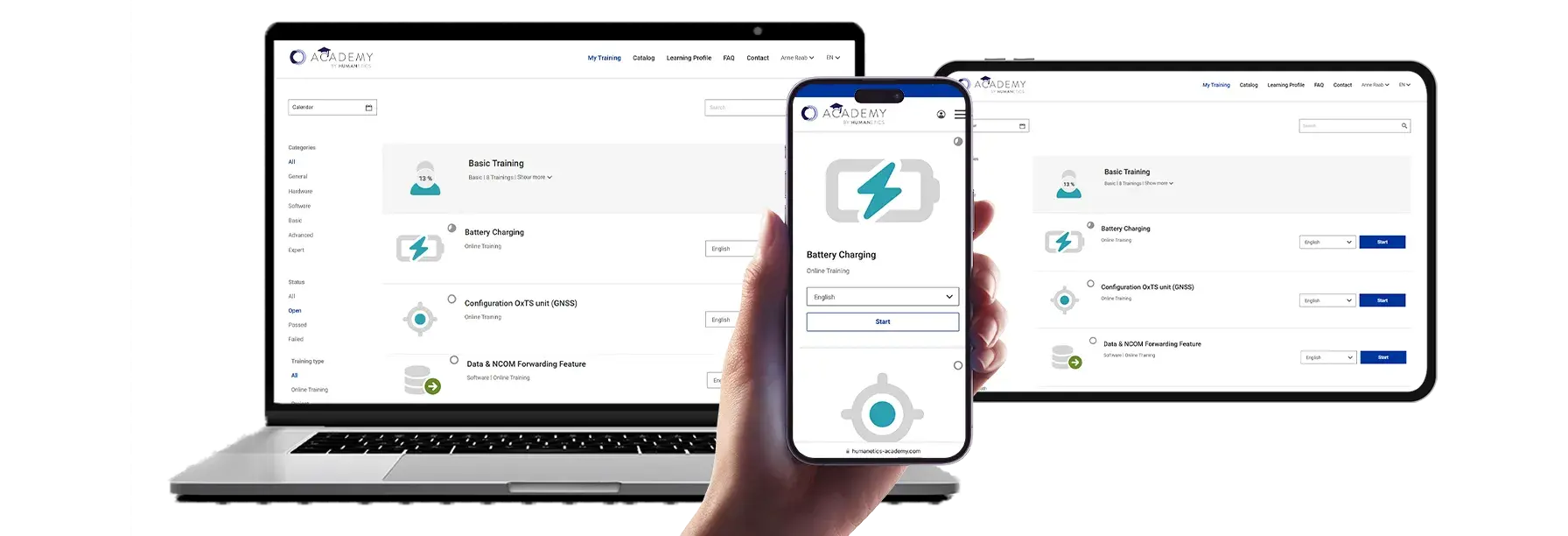
The Academy’s curriculum mirrors the daily workflow of a test engineer. Modules cover infrastructure setup, hardware configuration, GNSS and communications, and safety practices. Other modules dive into UFObase™ software and the operation of DrivingRobots™. Each course is designed to provide both context and practical steps, so lessons learned translate directly to behavior on the track.
Certification and Confidence
Every engineer who completes an Academy course earns a certificate that validates their skills. This matters for both the individual and the organization. Supervisors gain a reliable way to assign responsibilities. Engineers gain recognition for their expertise, which supports their career development. Proving grounds gain credibility with partners and regulators, showing that training is not improvised but structured and documented.

A Culture of Expertise
What we see with the Academy is not just improved skills, but a stronger culture of expertise. Teams that train together develop shared habits and shared language. They check equipment the same way, follow the same procedures, and trust that their colleagues are operating with the same knowledge. That shared foundation reduces risk, improves communication, and ultimately supports better results.
This culture also helps organizations adapt to the increasing demands of ADAS and AV testing. As scenarios grow more complex and involve more systems running in parallel, confidence in both the equipment and the people who operate it becomes even more important. The Academy provides that confidence.
Continuous Development
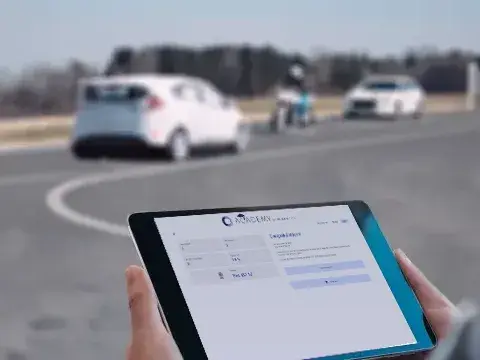

The Academy is not static. It evolves with our systems. Today, we offer comprehensive courses for UFOpro®, UFOmicro®, and UFOnano®, as well as DrivingRobots™. We cover infrastructure, batteries, hardware, and software. New modules are being developed to expand TrackBase training, from scripting in TrackBase Control™, to performance monitoring in TrackBase Analyze™, and site-wide coordination in TrackBase Connect®.
This continuous development ensures training keeps pace with technology. As our products evolve, so do the resources that help teams use them effectively. Engineers stay current without waiting for new manuals or one-off sessions.
The Academy becomes a living extension of the Humanetics ecosystem.
Preparing for What Comes Next
The trajectory of the industry is clear. Scenarios will become more complex, expectations for validation will become stricter, and public trust in automated safety will depend on flawless execution. To succeed in that future, organizations need both the right systems and the right people.
The Active Safety Academy delivers that preparation. It turns essential knowledge into an accessible, always-current resource. It reflects how our systems are actually used, so lessons learned in a module apply directly to behavior on the track. Most importantly, it supports our mission to protect humans in motion.
By combining advanced equipment with structured training, Humanetics ensures that test teams are not only equipped with the right tools, but are also prepared to use them to their fullest, today and tomorrow.
Interested in More Content Like This?
Subscribe to the Humanetics Pulse newsletter to learn more about Humanetics Products, News, and Industry Updates.
Expanding the Role of Training in Hardware Use
While software configuration often receives the most attention, much of the reliability of an ADAS test depends on how physical systems are set up, maintained, and handled. Here, structured training makes a measurable difference.
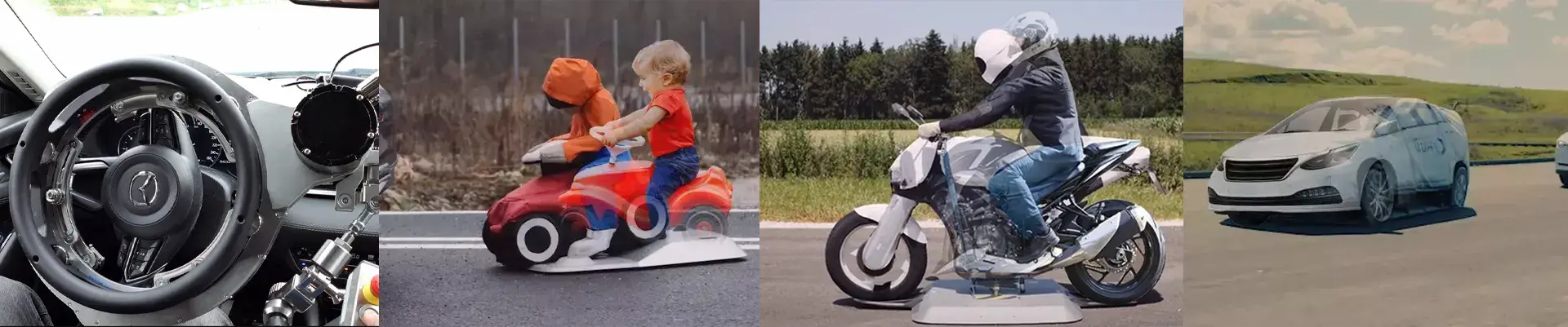
Take the UFO family of target carriers. These platforms, such as UFOpro®, UFOmicro®, and UFOnano®, are designed to reproduce the movements of pedestrians, cyclists, and powered two-wheelers. But using them effectively requires skill. Operators must know how to assemble and adjust ramps and set extension modules for stability. Training ensures these details are understood from the outset rather than learned through trial and error. The result is fewer interruptions, less wear on equipment, and more consistent test results.
DrivingRobots™ present a different challenge. These systems offer repeatable control of steering, braking, and acceleration across a wide range of vehicles, from passenger cars to buses. Their precision is measured in milliseconds. Training shortens the learning curve and reduces the risk of miscalibration that could invalidate an entire campaign.
Battery systems are another area where knowledge matters. Humanetics platforms use hot-swappable LiFePO4 batteries to minimize downtime. When managed properly, they provide reliable power and long service life. When managed poorly, they can cause unexpected shutdowns or require costly replacements. Training modules cover charging protocols, safe handling, and health monitoring, giving operators the understanding needed to keep systems running smoothly day after day.
Positioning and communication systems are fundamental to every scenario. GNSS units provide the accuracy needed for repeatable trajectories, while WIFI or mesh networks keep multiple actors in sync. A single misconfiguration can throw off alignment or delay communication. Training helps operators set up and verify these systems so that test runs deliver valid, useful data.
By addressing these hardware details through structured training, the Academy reduces preventable errors and prolongs the lifespan of the systems themselves. It shifts learning away from ad-hoc fixes toward a culture of preparation and shared expertise.
Guided Learning and Manager Oversight
The Academy isn’t just a resource for individual engineers; it also provides structure for team leaders. For instance, a recruit might start with hardware setup and safety, while a senior engineer concentrates on TrackBase scripting or advanced DrivingRobot™ functions.
Progress tracking allows supervisors to see who has completed training, who needs additional support, and where the team may require reinforcement. This structured approach turns training into a shared roadmap. Instead of relying solely on ad hoc mentorship, each engineer follows a defined path, ensuring consistency across sites and projects.
This consistency helps build confidence within the organization and with external partners who rely on test results. It also assists managers in balancing workloads, planning proving ground time more effectively, and ensuring the right expertise is always available when needed.
Speak to our experts
Fill out the below form and one of our experts will contact you

Markus Schmidl
Markus Schmidl joined the Humanetics team in 2012 with the goal of taking a thorough look at the product offerings and answering the question – how can we make these products even better than they already are? With his background in printing press machine sales at Heidelberger, Markus already knew that in a machine-driven workflow, maximum efficiency is critical to success.